
If your senior small dog has started hesitating at the bottom of the stairs or circling his bed twice as long before finally lying down, you already know the feeling in your chest that comes with it. You want to do something. So you go to Amazon, you search for joint supplements, and two names come up again and again: Cosequin and Zesty Paws Mobility Bites. Both claim glucosamine. Both are soft chews. Both have impressive review counts. But they are not the same product, and for a small senior dog, the differences matter more than the packaging suggests.
My 11-year-old Yorkie, Biscuit, weighs nine pounds and has been on a joint supplement for over two years now. I have tried more than one formula during that time. Here is what I have learned about how these two products actually compare when you get past the marketing.
| Price (current) | See current price on Amazon | See current price on Amazon |
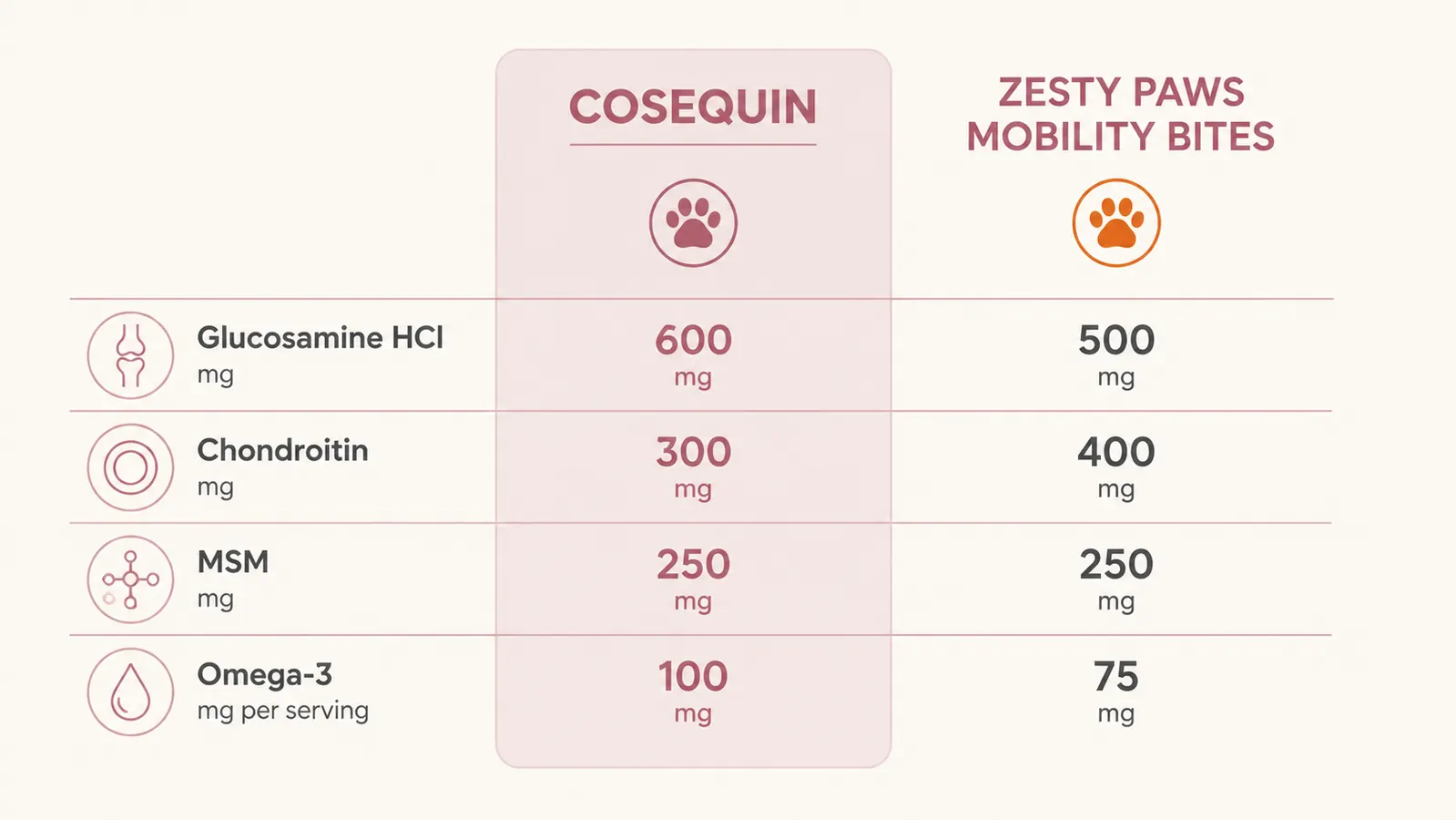
| Glucosamine source | Glucosamine HCl (shellfish-derived, pharmaceutical-grade FCHG49) | Glucosamine HCl (standard grade, source not specified) |
| Glucosamine per serving (small dog) | ~250 mg per chew, dosed by weight | ~100 mg per chew at baseline dose |
| Chondroitin | TRH122 chondroitin sulfate, 200 mg per chew | Chondroitin sulfate present, lower mg per serving |
| MSM included | Yes, MSM for additional joint support | Yes, MSM included |
| Omega-3 fatty acids | Yes, from fish oil (added anti-inflammatory) | No Omega-3 in Mobility Bites formula |
| Vet recommendation strength | Recommended by vets; No. 1 vet-recommended brand per third-party surveys | Popular retail brand, not widely cited by vets in clinical settings |
| Amazon reviews | 78,484 reviews, 4.7 stars | Mobility Bites SKU has fewer reviews |
| Palatability for small dogs | Chicken-liver flavored; most small dogs take willingly; occasional picky refusals | Reportedly very palatable; designed for grab-and-go appeal |
| Formula transparency | Named research-backed ingredient strains (FCHG49, TRH122) on label | Standard ingredient names without strain designations |
| Made in USA | Yes, manufactured in USA | Yes, manufactured in USA |
Where Cosequin Wins
The clearest advantage Cosequin holds is ingredient traceability. When you read the label on Cosequin DS (Double Strength), you see two specific ingredient designations that most supplement brands skip entirely: FCHG49 glucosamine and TRH122 chondroitin sulfate. Those are not just marketing names. They are the specific strains used in published veterinary research on joint support in dogs. Nutramax, the company behind Cosequin, funded and published much of that research, which is worth knowing. But the research itself is real and peer-reviewed, and the strains on the label match the strains in the studies. Zesty Paws Mobility Bites does not carry those designations. That does not mean the glucosamine in their product does not work, but it does mean you cannot trace it back to a clinical study the way you can with Cosequin.
The Omega-3 addition in Cosequin is the other factor I keep coming back to. Joint inflammation in aging dogs is not purely a cartilage problem. Chronic low-grade inflammation plays a role, and fish oil fatty acids address that pathway. Zesty Paws Mobility Bites leaves Omega-3 out of the formula entirely. If you are already giving your dog a separate fish oil supplement, this matters less. If you are not, you are getting one fewer tool in the box with the Zesty Paws product, even though the price points are similar.
Where Zesty Paws Mobility Bites Wins
Palatability is the one area where Zesty Paws legitimately outperforms. The Mobility Bites are designed to taste like a treat first and a supplement second, and most dogs agree. Biscuit, my Yorkie, eats Cosequin without complaint when I bury it in his kibble, but I have read enough reviews from small-dog owners to know that some picky eaters reject the chicken-liver chews. Zesty Paws puts more emphasis on flavor design, and for a dog who already side-eyes anything new in his bowl, that can be the deciding factor in whether the supplement actually gets consumed. A supplement your dog refuses is worth nothing, so this is a real consideration, not a minor footnote.
The Zesty Paws product also tends to have brighter, more modern packaging and is often easier to find in big-box pet stores if you want to grab something in person rather than wait for a delivery. That is not a clinical advantage, but convenience is real, especially when you are trying to stay consistent with a daily supplement routine.
Cosequin has 78,000 reviews and vet backing because the formula earns it. See today's price.
If your senior dog is showing the first signs of joint stiffness, Cosequin DS soft chews are the formula most vets point to first. The research-backed glucosamine and chondroitin strains, combined with MSM and Omega-3, give you more tools per chew than the alternatives.
Amazon Check Today's Price on Amazon →
The Glucosamine Question: Does Source Actually Matter?
This is the part of the comparison that most pet product review sites skip past. Glucosamine is not a single thing. It exists in multiple forms, and the form matters for how well the compound is absorbed and retained in joint tissue. Glucosamine HCl, which both products use, is more concentrated than glucosamine sulfate, so a lower mg number on the label is not automatically worse. But the research supporting Cosequin specifically used the FCHG49 strain of glucosamine HCl, and those studies showed measurable improvements in mobility in dogs with joint disease over an eight-week period. There is no equivalent published research tying the Zesty Paws Mobility Bites formula to clinical outcomes in dogs. That does not mean their glucosamine fails, but the burden of proof sits differently between the two products.
A supplement your dog refuses every other day is not doing anything for his joints. But a supplement with weaker ingredients he eats happily is not doing enough either. The goal is the best formula your specific dog will actually take every single day.
What About Chondroitin Levels?
Chondroitin sulfate works alongside glucosamine to slow the breakdown of cartilage and support the retention of water in joint tissue. The concentration per serving matters. Cosequin DS delivers 200 mg of TRH122 chondroitin sulfate per soft chew, which is a meaningful dose for a small dog in the 8-to-20-pound range when dosed correctly by weight. The Zesty Paws Mobility Bites product has a lower chondroitin concentration per serving at the standard dose. For a nine-pound Yorkie, that gap can be the difference between a therapeutic dose and a sub-therapeutic one. I am not a veterinarian, and your vet should guide your dog's specific dose, but the numbers on the label are publicly available and worth comparing directly before you buy.
Vet Recommendation Strength: A Real Difference
Cosequin is the joint supplement my vet mentioned by name the first time Biscuit came in with early signs of stiffness. I did not have to ask about it. She brought it up herself, said it was what she recommends most often for small-breed dogs because the research base is the strongest of any OTC joint supplement on the market. I have heard similar things from friends whose vets practice in different states. Zesty Paws is a well-known consumer brand with strong retail presence and good marketing, but it is not the brand that comes up first in veterinary conversations about joint care. If you are going to ask your vet at the next appointment, bring both bottles and ask them to compare the ingredient strain designations. That conversation usually settles the question quickly.
Who Should Buy Which
Buy Cosequin if your dog is already showing joint stiffness and you want the formula with the strongest clinical backing and the highest chondroitin dose per serving. The vet recommendation rate is not marketing noise. It reflects a formula that has been studied directly in dogs and published in peer-reviewed journals. The Omega-3 addition is a genuine bonus for small senior dogs who deal with chronic inflammation. This is the product I use for Biscuit, and it is the one I would point any fellow dog mom toward first.
Consider Zesty Paws Mobility Bites if you have tried Cosequin and your dog refuses it flat-out, and if you have confirmed with your vet that the lower chondroitin level is acceptable for your dog's size and current joint condition. It is a reasonable second option for a picky eater who needs something, and something used consistently beats something better that sits untouched. But go into it knowing the tradeoff you are making.
For most small-breed senior dog owners, Cosequin is the clearer answer. The formula is more complete, the ingredient sourcing is more transparent, the vet endorsement is stronger, and the review base of nearly 80,000 customers gives you real-world confidence that spans many different breeds, sizes, and ages. The only reason to choose otherwise is palatability failure with your specific dog, and even then, I would try burying a Cosequin chew in a small amount of plain chicken before switching formulas.
Ready to try the formula vets actually recommend? Here is where to check today's price.
Cosequin DS soft chews from Nutramax are the most-researched OTC joint supplement for dogs. For a senior small-breed dog showing early stiffness, starting here means you are starting with the strongest formula available without a prescription.
Amazon Check Today's Price on Amazon →