
My Yorkie, Penny, is eleven years old and weighs eight pounds. She came to me at age four from a puppy mill rescue, arthritic joints already beginning to form from a life spent in a wire cage. For two years I did not notice anything alarming. Then one spring morning I watched her circle her favorite bed six times before carefully, slowly lowering herself down. She had done that three times the night before. And suddenly I was paying very close attention.
Joint pain in senior dogs rarely arrives with a dramatic limp. It arrives quietly: a hesitation at the bottom of the stairs, a reluctance to jump onto the couch they have used for years, stiffness in the first few minutes after a nap. If you have noticed any of those things in your dog, you are not overreacting. You are catching it early, and that matters. Here is what I have learned, step by step, about supporting a senior dog through joint pain at home.
If your senior dog is already stiffening up after rest, this is the supplement most vets point to first.
Nutramax Cosequin contains glucosamine, chondroitin, MSM, and omega-3 in a single soft chew. With nearly 80,000 reviews and clinical use behind it, it is the starting point I recommend for any senior dog showing early joint changes.
Amazon Check Today's Price on Amazon →Step 1: Get a Vet Baseline Before You Change Anything
Before you buy a ramp, switch her food, or add a supplement, make one phone call: to your vet. Joint stiffness in an older dog usually is what it looks like, but it can also be a symptom of Lyme disease, hypothyroidism, or spinal compression that responds very differently to home management. A baseline visit, ideally with X-rays if your vet recommends them, tells you whether you are dealing with age-related osteoarthritis, something more acute, or a combination of both.
When I brought Penny in after noticing her circling, her vet confirmed mild hip dysplasia and early arthritis in her back legs. That diagnosis gave me a clear path. I knew I was managing a chronic, progressive condition, not something that would resolve on its own. My vet's first recommendation, before anything else, was a glucosamine-chondroitin supplement. Her second recommendation was weight management. We will get to both.
Write down your dog's current weight, gait observations, and any specific behaviors you have noticed. Bring that list to the appointment. Vets see a lot of patients and a detailed owner report helps them move faster to the right answer.
Step 2: Manage Weight With More Precision Than You Think You Need
This step is uncomfortable to talk about because most of us, myself included, have at some point used food as love. But extra weight on an arthritic joint is not kindness. In a small dog, even one pound of excess weight adds four to five pounds of force per step on those joints. If Penny is supposed to be seven pounds and she is carrying eight and a half, every walk on tile or concrete is meaningfully harder on her hips.
Ask your vet for a target weight range and a daily calorie count. Measure food by weight, not by the cup markings on your scoop, which vary by kibble density. If you give treats (and I do, because Penny has earned them), count those calories against her daily total. For small breeds, even a thirty-calorie training treat adds up quickly. Switch to lower-calorie options like a single blueberry or a thin slice of apple if you give treats frequently.
Weight management is not about deprivation. It is about giving arthritic joints the best possible mechanical advantage. A dog at her ideal weight moves with less pain and less inflammation than a dog carrying even a modest extra load.
Step 3: Replace High-Impact Exercise With Low-Impact Movement
The instinct when a dog seems sore is to let her rest completely. That is usually the wrong call. Muscles that support arthritic joints need to stay active. Rest leads to muscle atrophy, which leads to weaker joint support, which leads to more pain. The goal is to shift the type of exercise, not eliminate it.
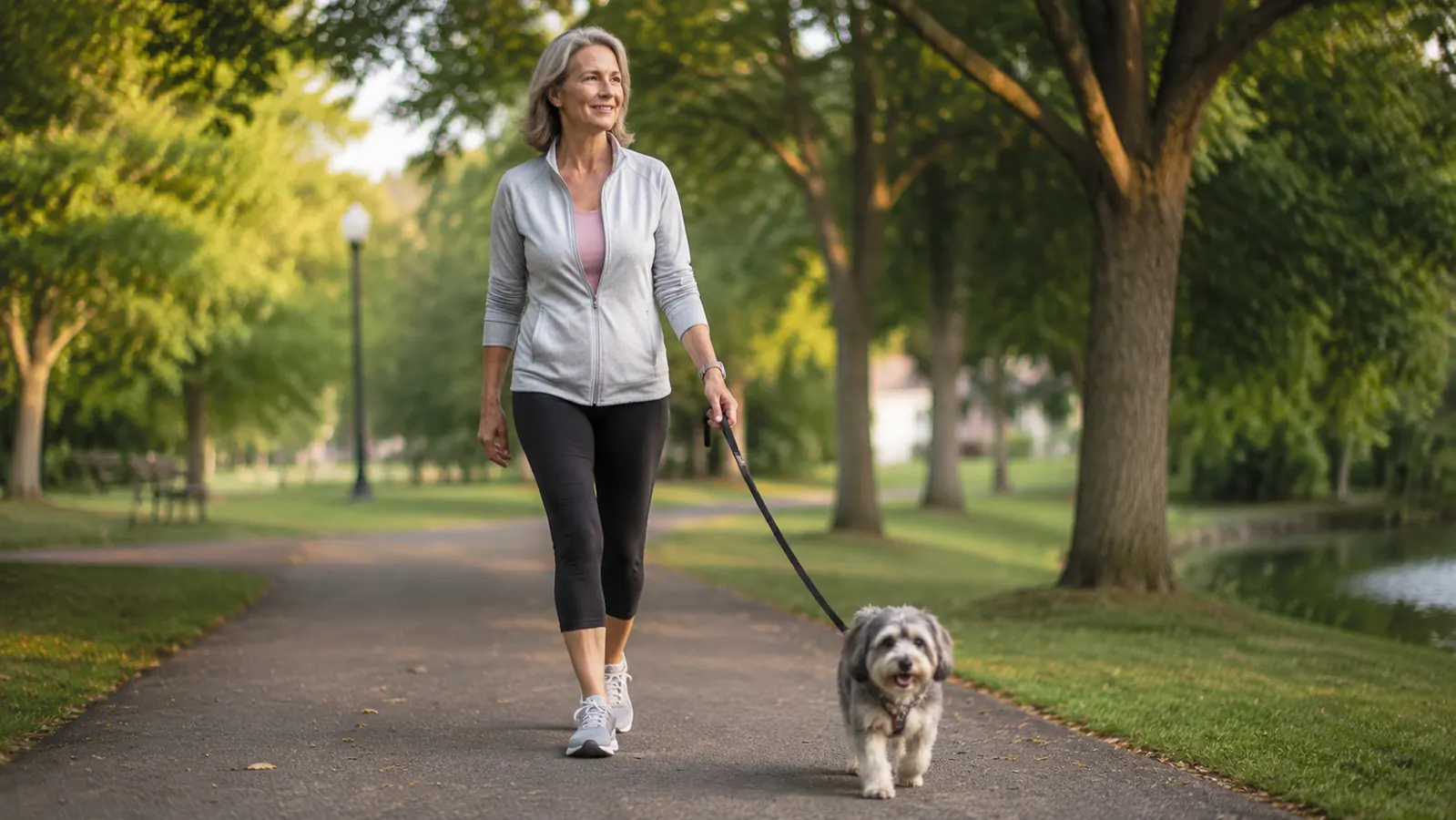
Short, flat walks on soft surfaces are ideal. Grass is better than concrete. A flat neighborhood sidewalk is better than stairs or hills. For Penny I switched from one twenty-minute walk to two ten-minute walks, which gives her joints a recovery window. I keep the pace slow enough that she sets it, not me. On days when Florida humidity makes even a gentle walk feel like an effort, I give her five minutes of slow backyard sniffing instead. Mental engagement counts.
Avoid repetitive jumping, fetch on hard surfaces, and any activity that requires sudden stops or pivots. Swimming is excellent for arthritic dogs if you have access to a safe, calm body of water, but it is not required. The most important thing is consistent, gentle daily movement.
Muscles that support arthritic joints need to stay active. Rest leads to atrophy, which leads to weaker support, which leads to more pain. The goal is to shift the type of exercise, not eliminate it.
Step 4: Set Up Your Home to Reduce the Effort of Movement
A senior dog with joint pain should not have to negotiate a single unnecessary jump or stair. Walk through your home with this in mind and identify every place where she currently has to leap or climb. The bed, the couch, the car, even a single step between rooms if your house has a split level. Each of those points is a pain event she endures multiple times a day.
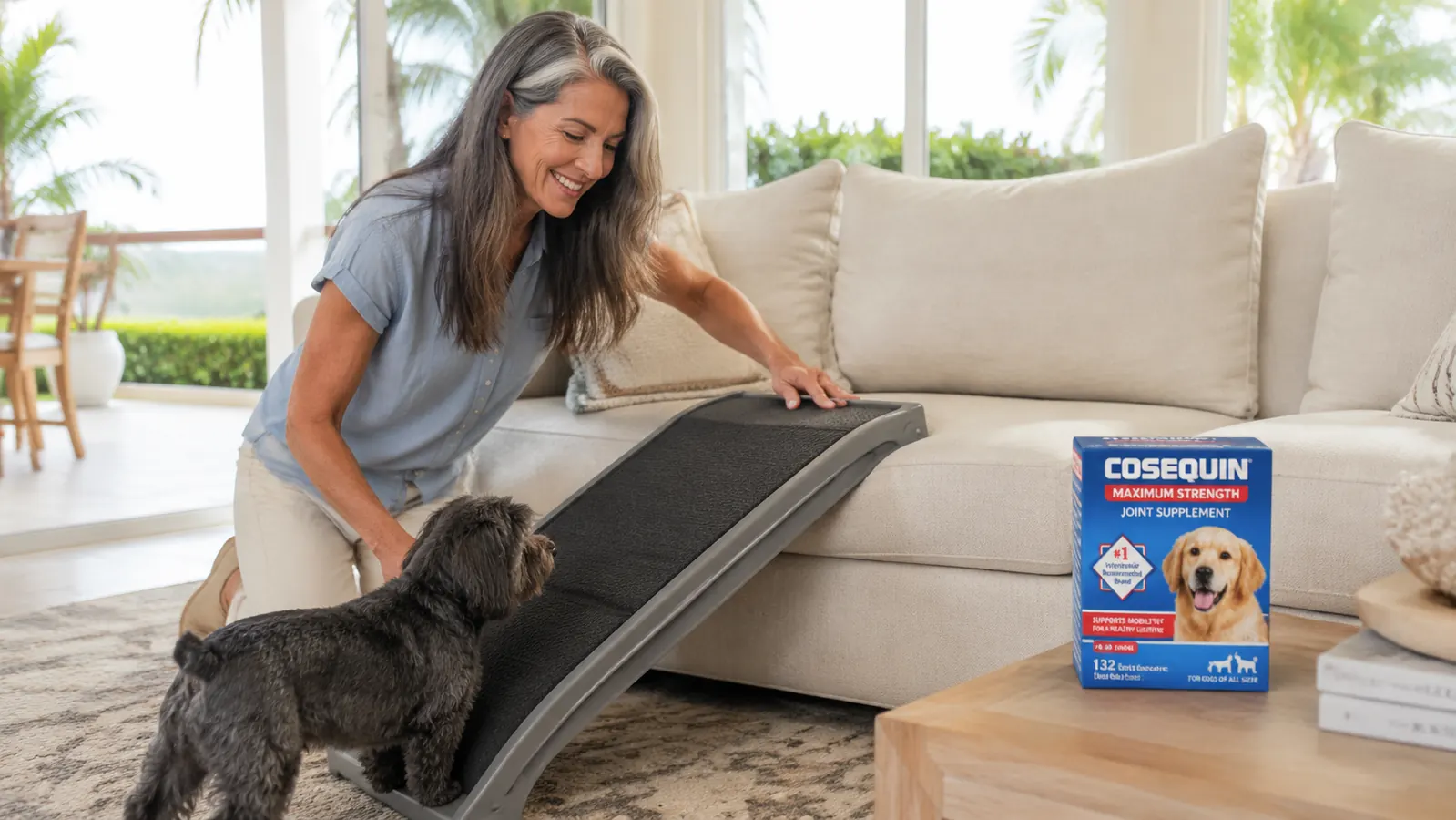
Dog ramps are the single highest-impact home modification for a small-breed senior. A low-profile ramp from floor to couch or bed allows her to keep sleeping in the places she loves without the joint impact of jumping. It takes a few days for most dogs to learn the ramp. I used a trail of small treats along the surface to teach Penny, and by day three she was walking up it without hesitation. Ramps with a non-slip surface and a gentle incline are the ones worth buying. Steep angles just create a different version of the problem.
Also consider non-slip flooring. Hardwood and tile are beautiful and brutal for an arthritic dog trying to get her footing. Rubber-backed rugs or washable yoga mats placed along the routes she walks most often reduce slipping and the muscle effort that goes into compensating for it. In our house I have a mat run from the bedroom doorway to her water bowl to her favorite chair. She walks that path twenty times a day and the rugs have eliminated the hesitation I used to see every time she hit a bare patch of floor.
Step 5: Replace Her Bed With Orthopedic Support
A dog who sleeps eight to fourteen hours a day is spending most of her life in one spot. If that spot is a flat cushion or a thin padded mat, her joints are not getting the pressure relief they need. Orthopedic memory foam or supportive foam beds distribute weight evenly and prevent the pressure points that form on hips and elbows when a dog sinks into a soft, unsupportive surface.
For a small senior dog, look for a bed with a low entry point (so she can step in without stepping up), a bolstered edge she can rest her head on without craning her neck, and a washable cover because senior dogs often have incontinence issues or simply track in more debris. The bed should hold its loft after washing. If it flattens to two inches after a few cycles, it has lost its orthopedic value.
Placement matters as much as the bed itself. Keep it away from air conditioning vents and drafts, which stiffen arthritic joints the way cold weather stiffens an old injury in people. In South Florida this means positioning beds on interior walls and away from the direct blast of AC units, which run most of the year.
Step 6: Add a Vet-Approved Joint Supplement to Her Daily Routine
This is the step most owners eventually arrive at, and the confusion comes from the sheer volume of products making similar claims. Walk into any pet store and you will find fifteen options. They are not equivalent. The ingredients that have actual clinical research behind them are glucosamine and chondroitin, and the formulas that also add MSM and omega-3 fatty acids give you additional anti-inflammatory support without needing a separate fish oil supplement.
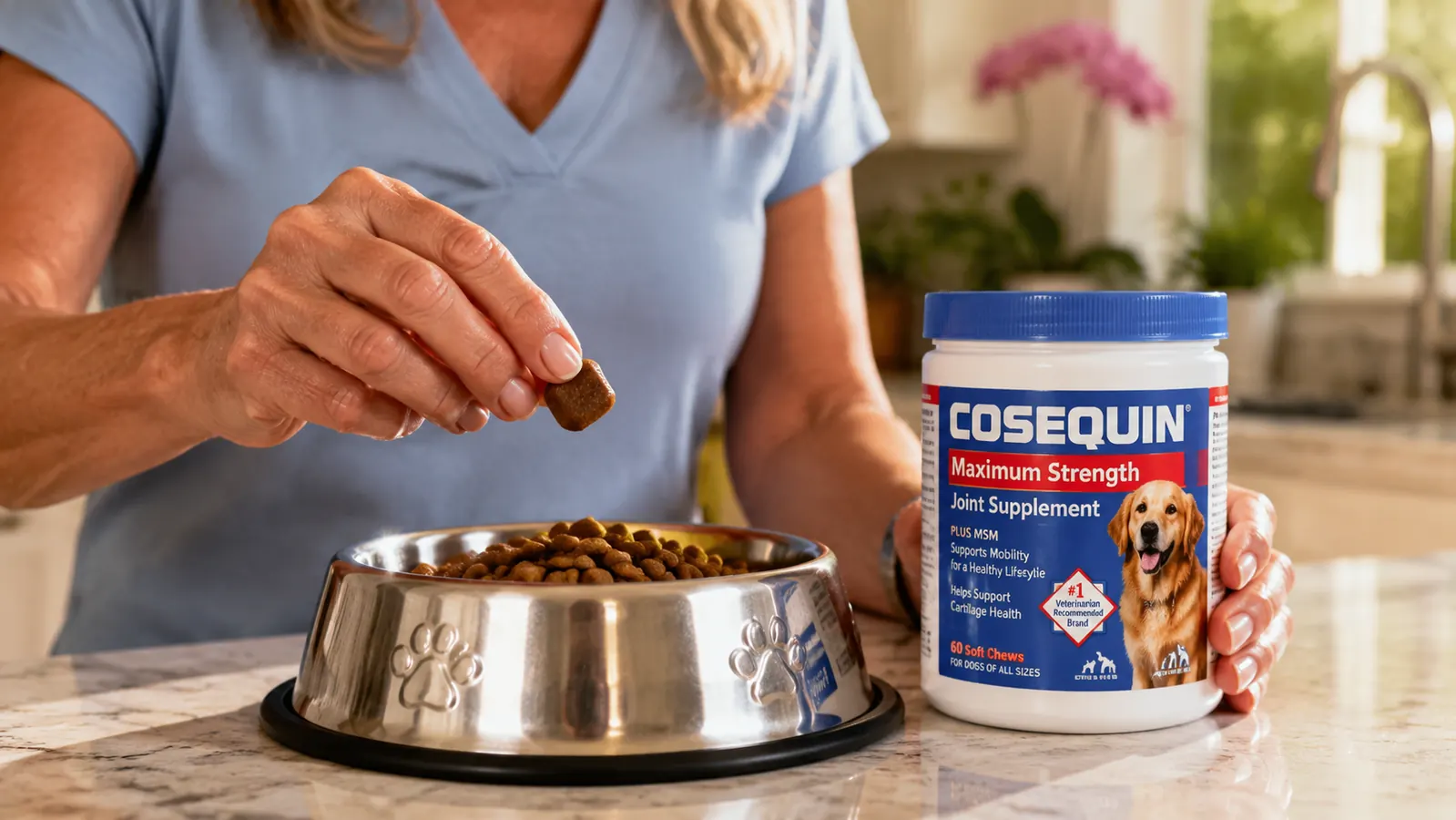
Nutramax Cosequin is the product my vet named before I had even finished describing Penny's symptoms. It contains glucosamine, chondroitin, MSM, and omega-3 in a single soft chew. Nutramax is one of the few pet supplement manufacturers that conducts and publishes its own clinical research, which is why veterinarians reach for it first rather than recommending a store brand. The soft chew format is important for older dogs whose teeth may be worn or sensitive. Penny takes hers hidden in a small piece of boiled chicken breast every morning.
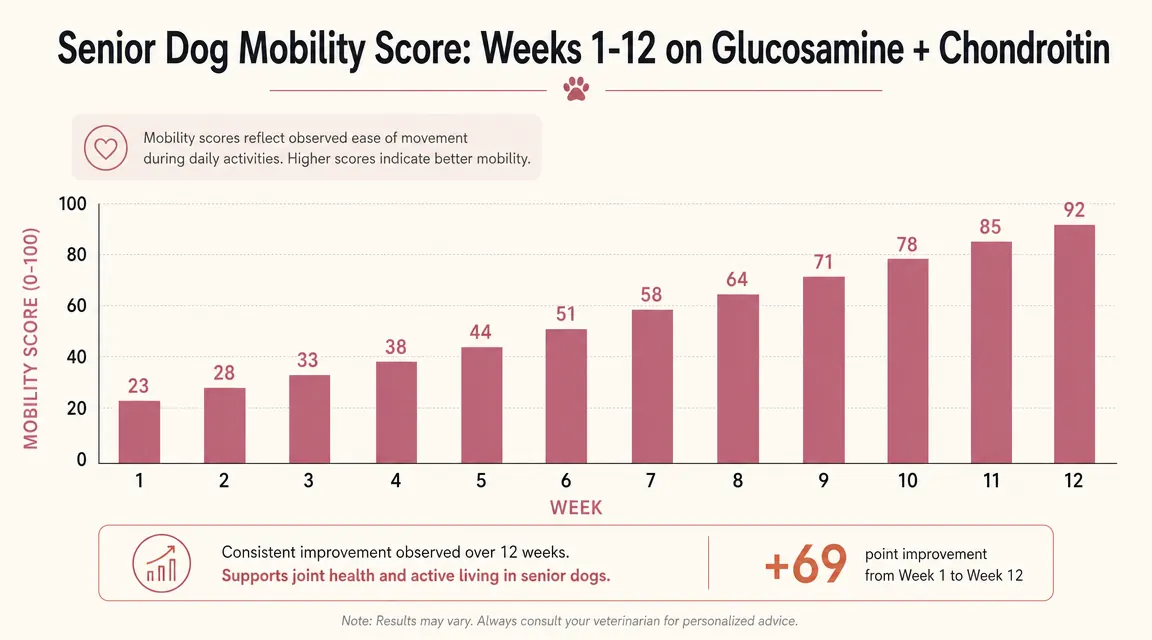
Set realistic expectations before you start. Glucosamine and chondroitin work by supporting cartilage integrity and reducing inflammation over time. Most owners see meaningful changes in mobility at four to six weeks, with the clearest improvement visible at eight to twelve weeks. If you stop after two weeks because you do not see dramatic results, you have not given the supplement a fair trial. I tracked Penny's stair hesitation and bed-circling count on a simple notepad for the first three months. By week eight, the circling had dropped from six times to one or two.
For more detail on what makes this formula different from the alternatives, see our full write-up in the Cosequin long-term review. And if you are still deciding whether your senior small dog needs glucosamine at all, the 10 reasons to start glucosamine article walks through the case for starting earlier rather than waiting.
Nutramax Cosequin: the supplement your vet is most likely to name first for senior joint support.
Glucosamine, chondroitin, MSM, and omega-3 in one soft chew. Nearly 80,000 Amazon reviews. Manufactured by a company that publishes its own clinical research. This is where I started with Penny and where I would start again.
Amazon Check Today's Price on Amazon →What Else Helps
Beyond the six core steps, a few smaller adjustments make a consistent difference. Warm compresses applied gently to sore hip or shoulder joints for five to ten minutes after a walk can ease inflammation the same way they ease a sore muscle in a person. Raised food and water bowls reduce the strain of bending the neck and shoulders at mealtime, which matters for dogs whose arthritis has spread to the front legs or spine. Massage, done gently and with attention to the dog's response, improves circulation and keeps tight muscles from adding to joint stress. YouTube has excellent tutorials on canine massage for arthritic dogs if you want a guided starting point.
Cold laser therapy, hydrotherapy, and acupuncture are all legitimate adjunct treatments that veterinary physical therapists offer, and they are worth asking about if your dog's condition is not responding well to home management alone. They are not replacements for the foundational steps, but they can provide meaningful additional relief for dogs with moderate to severe arthritis. Ask your vet for a referral to a certified canine rehabilitation therapist if you want to explore them.
The last thing I will say is this: do not wait for the dramatic limp. The quiet signs, the circling, the stair hesitation, the early morning stiffness that loosens up after twenty minutes of moving around, those are your earliest window to intervene while the cartilage still has something worth supporting. Penny is eleven now. She is slower than she was at eight and she will continue to change. But she still walks to her bowl with purpose, still wants her morning walk, still climbs her ramp to sleep in the spot she has claimed for three years. That is what good management looks like: not reversal, but preservation of quality and comfort for as long as possible.