Penny, my rescue Yorkie, slept in short, restless bursts for the first four months she was with me. She had come from a puppy mill where there were no beds at all, just wire grates. Once she got here, the combination of a new house, new smells, and a lifetime of learned anxiety meant that even when she was clearly exhausted, she could not stay asleep. She would circle for ten minutes, lie down for twenty, then pace again. I tried everything before I figured out that the problem was not one single thing. It was a combination of the wrong bed, the wrong placement, the wrong temperature, and the absence of any consistent routine. Once I addressed all of it together, sleep improved within a week. This guide walks through exactly what I did, step by step. It turned out to be the orthopedic bed.
If your small dog wakes frequently, takes forever to settle, startles at minor sounds, or chooses to sleep on the floor instead of her bed, she is not just being difficult. These are signals. Small breeds, especially rescues and senior dogs, have nervous systems that need more environmental support than most people realize. The good news is that nearly every one of these sleep problems has a practical fix, and none of them require a vet visit.
The bed that helped Penny finally sleep through the night
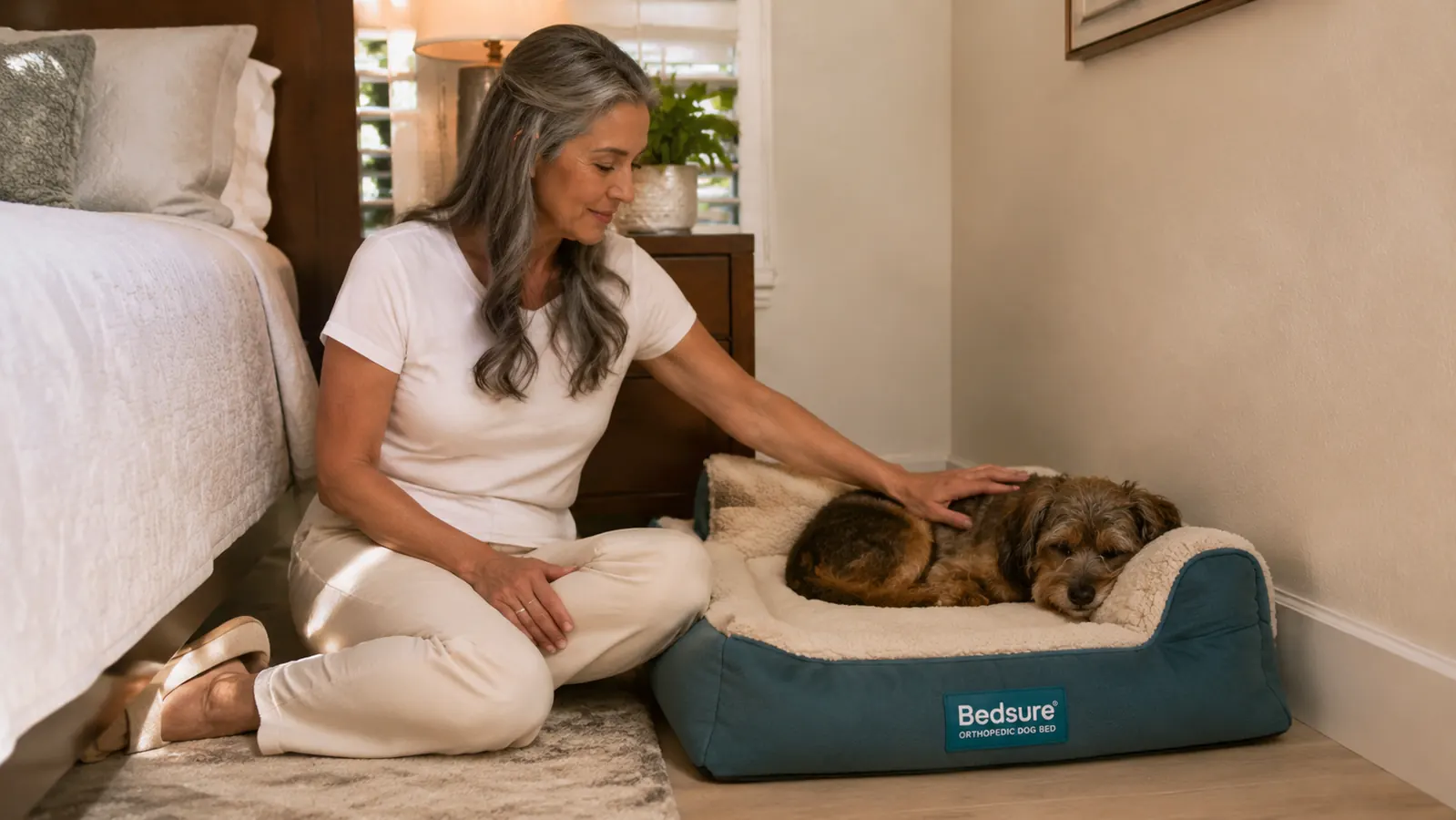
The Bedsure Orthopedic Dog Bed gives small dogs the bolstered walls they want to press against and the memory foam support their joints need underneath. Over 51,000 reviews, machine-washable cover, and it comes in sizes made specifically for small breeds. If you are going to change one thing first, change the bed.
Amazon Check Today's Price on Amazon →Step 1: Audit the Bed Your Dog Is Actually Sleeping On
Most small-dog sleep problems start here and stay here because owners assume their dog just has poor sleep habits. But a flat, overly soft bed with no sidewall support is almost useless for a small dog. Small breeds, especially anxious ones, have an instinct to press against something solid when they rest. In the wild, that would be a den wall or a packed-down patch of grass with a raised edge. In your living room, that means a bolster bed with a firm raised perimeter that your dog can lean her back or chin against. A flat pillow bed, no matter how expensive, does not give her that.
The second issue is foam quality. The cheap polyester fill in most beds compresses within a few weeks until the dog is essentially sleeping on the floor with fabric over it. If you can press your hand flat through the bed to the floor without much resistance, your dog is not getting any support. For small breeds under 15 pounds, especially those with even minor joint stiffness, that lack of support translates directly to restless sleep and frequent position changes. An orthopedic memory foam base holds its shape through weight cycles in a way that loose polyester fill never does.
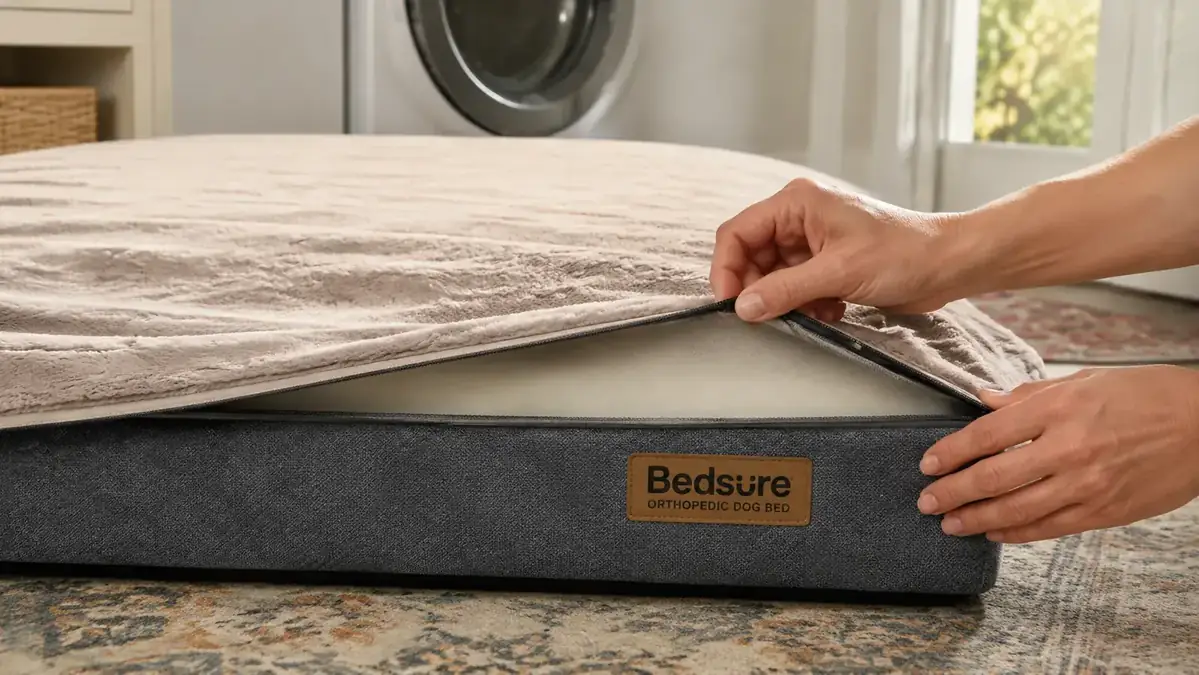
The Bedsure Orthopedic Dog Bed for small dogs addresses both of these issues. The bolster walls run along three sides and are firm enough for a dog to lean against without collapsing. The base is egg-crate orthopedic foam, not shredded scrap or loose fill. And the cover comes off for machine washing, which matters because a bed that smells like accumulated stress will not help an anxious dog relax. I washed Penny's cover every ten days for the first two months and noticed that the nights after a fresh cover went on were consistently quieter than the nights before I got around to washing it.
Step 2: Choose the Right Placement in the Room
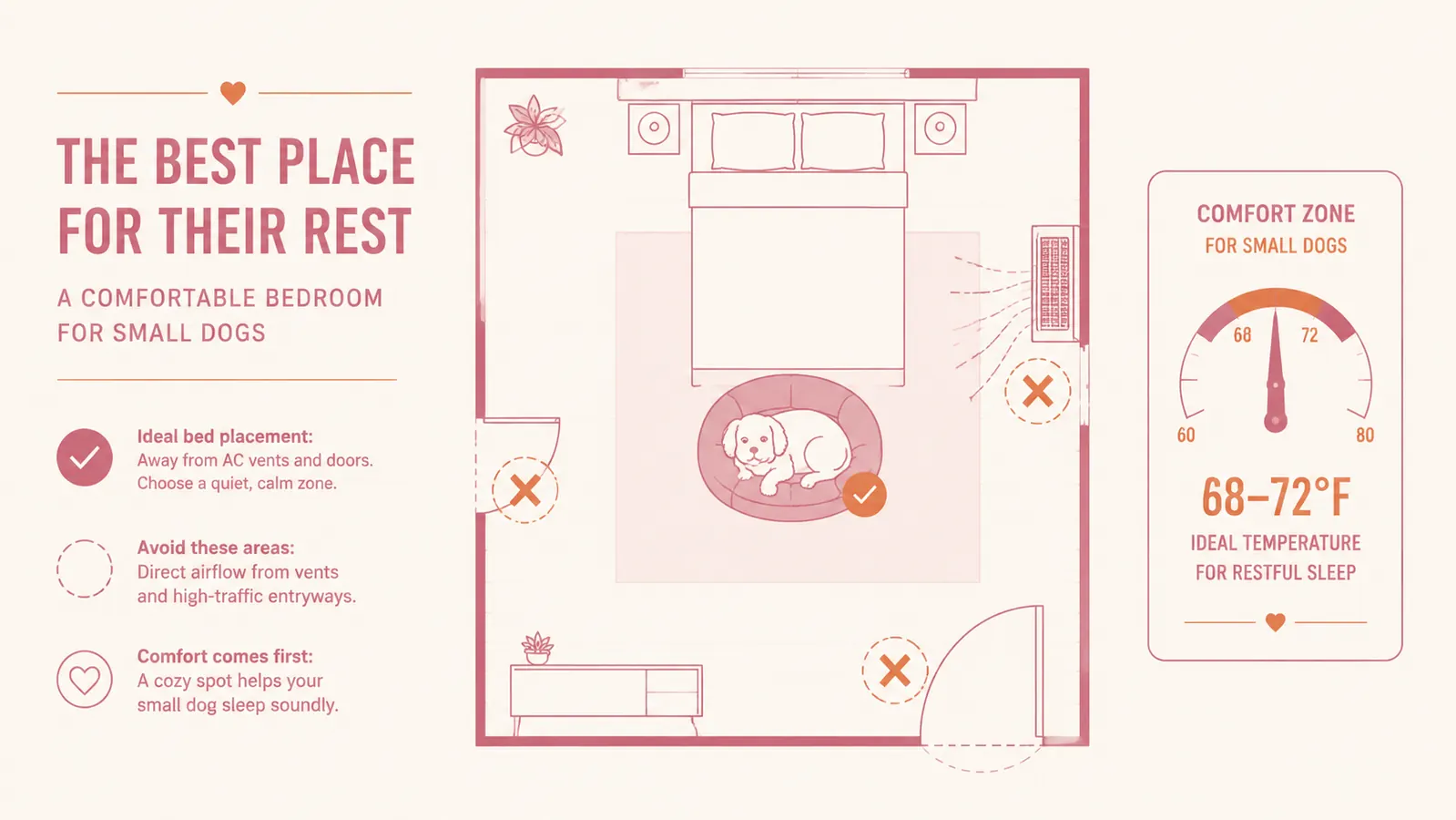
Where you put the bed matters almost as much as which bed you choose. The three biggest placement mistakes I see are: too close to an exterior door (door sounds, drafts, foot traffic), directly under or next to an air conditioning vent (temperature shock every time the AC kicks on), and in the middle of an open room with no wall nearby (no security boundary for the dog). Small dogs, particularly anxious ones, sleep best when the bed is tucked against a wall or into a corner with a clear sightline toward the room entrance. This gives them the back-protected, forward-watching position their instincts prefer.
In practice, this usually means moving the bed from wherever looked aesthetically nice to wherever the dog gravitates naturally. Penny told me exactly where she wanted her bed by refusing to sleep in the one I had placed decoratively near the window and instead curling up in the corner near the bedroom door where she could watch the hallway. I moved the Bedsure bed to that corner, and she was on it within ten minutes. Dogs are not being stubborn when they avoid the bed you carefully chose. They are telling you the location does not feel safe. Follow the dog.
Penny told me exactly where she wanted her bed by refusing to sleep in the one I placed near the window and instead curling up in the corner near the bedroom door. Dogs are not being stubborn when they avoid the bed you picked. They are telling you the placement does not feel safe.
Step 3: Get the Room Temperature Into the Right Range
Small dogs have a higher surface-area-to-body-mass ratio than large dogs, which means they lose body heat faster. In South Florida this is rarely a problem in summer, when most small dogs are actually too warm at night and sleep restlessly because of it, but it becomes a real issue in winter months when AC-heavy homes drop below 68 degrees at night. The comfortable sleep range for most small breeds is 68 to 72 degrees Fahrenheit. Below that, they wake up cold. Above 75, they wake up panting and repositioning.
If your home runs cool at night and your small dog sleeps in restless spurts, try adding a thin fleece blanket she can burrow under rather than raising the thermostat for the whole house. Most small dogs will pull a blanket over themselves or push under it within a few nights once they learn it is available. The bolster design of the Bedsure bed helps here too, because it creates a partial enclosure that retains some body heat around the dog even without a blanket. This is one of the reasons flat beds fail anxious small dogs, they have no warmth retention and no sense of enclosure.
Step 4: Build a Pre-Sleep Routine and Stick to It
This is the step most people skip because it sounds soft, but it is one of the highest-impact changes you can make for a small dog with anxiety. Dogs do not generalize time the way we do. They track routines. A dog who knows that a 10-minute walk is followed by a small treat at the bed location is followed by the lights going low is a dog whose nervous system starts to wind down before she even lies down. Without a consistent sequence, the transition from alert daytime dog to sleeping dog requires her nervous system to figure it out fresh every night, and anxious dogs often cannot do that efficiently.
The specific routine matters less than the consistency. Penny's routine is a short walk, then a few minutes of gentle brushing, then I direct her to her bed and put a small piece of chicken breast on the lip of the bolster. She eats it, does her three circles, and settles. That whole sequence takes about 12 minutes. After six weeks of doing it at the same time each night, she started going to her bed on her own at approximately the right time, even on nights I forgot to initiate. The routine became her cue, not my direction.
One additional note: avoid high-energy play in the 30 minutes before you want the dog to sleep. Small dogs can go from flat-out sprint to crashed in about five minutes when they are puppies, but adult and senior small dogs, especially anxious ones, take longer to come down from arousal. A game of chase or excited tug at 10 PM can leave an anxious dog wired until midnight. Wind down before you want the dog to wind down.
Step 5: Reduce the Sound and Light Load at Bedtime
Small dogs have more sensitive hearing than humans. Sounds we tune out, the neighbor's AC compressor cycling on, a car door two houses away, a television in another room, register clearly to a small dog and can interrupt sleep even when the dog appears to be settled. This is especially true for former puppy-mill dogs and other rescues who learned early that unexpected sounds meant stress. Penny would startle awake at least twice a night in the first few months. Once I added a white noise machine near her bed, the number of visible startles dropped to near zero within a week.
You do not need anything fancy. A small fan on low running near but not directly at the bed creates enough ambient sound to mask the irregular noises that trigger startle responses. The key is that the fan should be on before the dog settles, not turned on after she is already asleep, which would itself be a startle. On the light side, make the sleep area visibly darker than the rest of the house at bedtime. Even leaving a bathroom light on with the door open a few feet can be enough ambient light to keep a dog from fully dropping into deep sleep. The Bedsure bed's bolster walls help here too by giving the dog a physical shroud to tuck her face into, which reduces her effective field of view and calms visual input.
What Else Helps
The five steps above address the structural causes of poor small-dog sleep. But a few additional items are worth knowing about. First, if your dog has visible joint stiffness, see a vet before assuming the sleep issue is purely behavioral. Dogs with early arthritis shift position frequently at night to relieve pressure, which looks like anxiety-driven restlessness but has a different root cause. An orthopedic bed helps either way, but a vet can tell you whether there is something additional to address. Second, for dogs with significant separation anxiety, a worn t-shirt with your scent placed inside the bolster can reduce nighttime anxiety, particularly in the first few months in a new home. Third, if you have a multi-bed household and your dog keeps choosing a different bed each night, that is usually fine. Let her choose. Consistency of routine matters more than consistency of which specific bed she uses.
The Bedsure Orthopedic Dog Bed holds up well to the kind of use a multi-bed household puts on it. The orthopedic foam base has not lost meaningful loft even after many months of nightly use and regular washing. The bolster walls hold their shape through washing cycles better than I expected given the price point. If you are comparing options, I have a detailed look at how the Bedsure holds up specifically on washability in the long-term review linked below, as well as a piece on the signs that your current small-dog bed has already stopped doing its job. Both are worth reading before you spend money on something that will disappoint you in six months.
See also: [10 signs your small dog needs an orthopedic bed](/10-signs-your-small-dog-needs-orthopedic-bed) and the full [Bedsure orthopedic dog bed review](/bedsure-orthopedic-dog-bed-review-long-term) for six months of detailed testing notes.
Ready to give your small dog a real sleep setup? Start with the bed.
The Bedsure Orthopedic Dog Bed is built specifically for small breeds, with bolster walls for security, egg-crate foam for joint support, a removable waterproof-lined cover that survives repeated washing, and a price that does not require you to choose between a good night's sleep for your dog and anything else in your budget. Over 51,000 verified ratings and a 4.5-star average. Check the current price before the size you need sells out.
Amazon Check Today's Price on Amazon →