
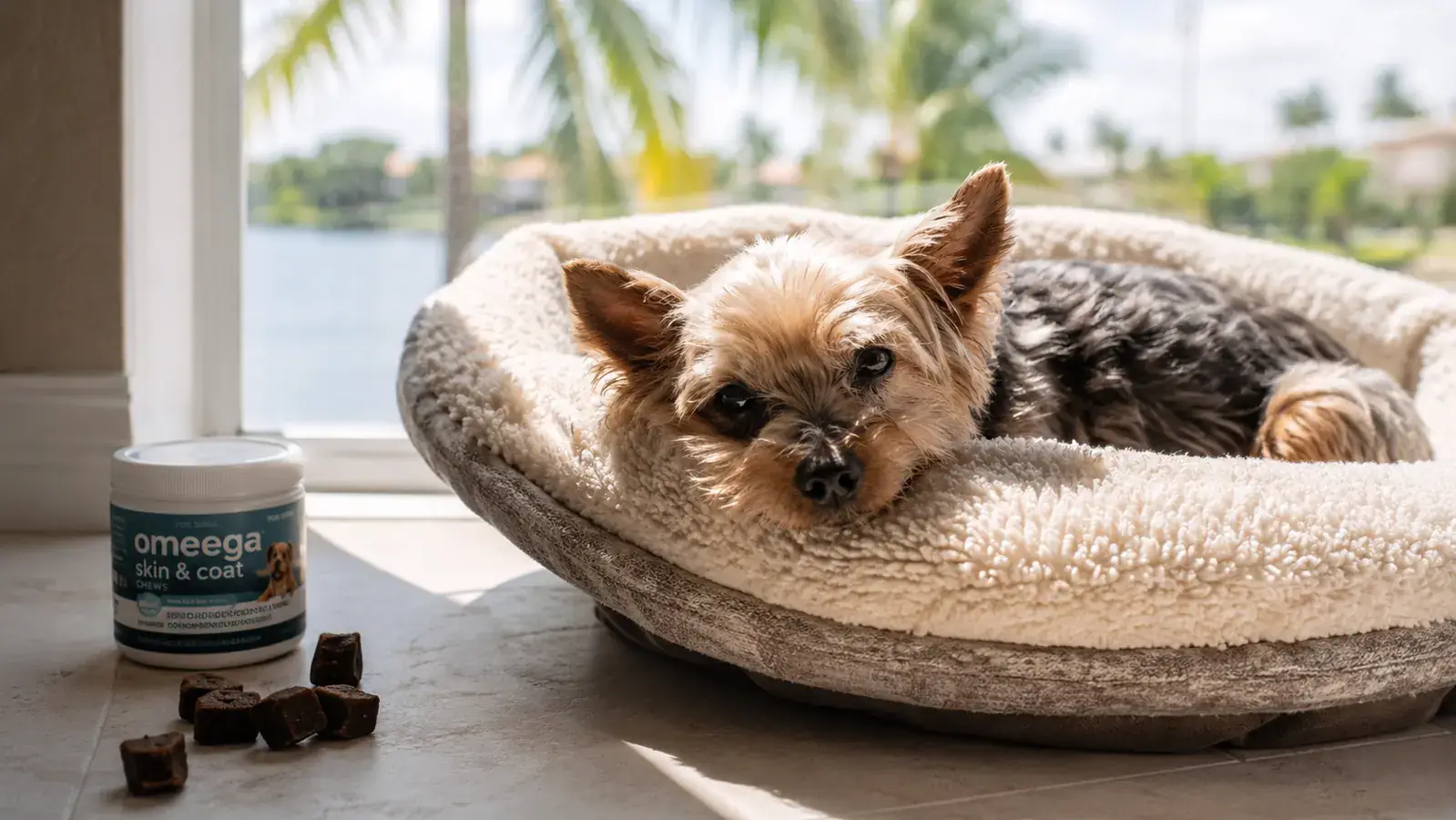
My Yorkie, Milo, is 11 years old and weighs nine pounds. He came to me at age six from a rescue that pulled him from a backyard breeder, and he has spent five years convincing me he is still a puppy. Last spring, he stopped convincing me. He started hesitating at the bottom of the three steps from the patio to the yard. He would stand there, looking up at me, then look back at the steps. That was new. That was the thing that made me actually read the ingredient labels on joint supplements instead of just buying whatever had the most stars.
Nutramax Cosequin was the supplement my vet mentioned first. It has 78,484 reviews on Amazon as of this writing, a 4.7-star rating, and a reputation that has been built over decades. It is genuinely well-regarded. But here is what I want to say before you add it to your cart: the reviews do not cover what I needed to know. They do not cover how to dose a nine-pound dog correctly, what to actually expect in the first 30 days versus the second 30 days, and most importantly, they do not tell you when Cosequin is not the right answer at all. This review does.
Quick Verdict
A clinically solid glucosamine-chondroitin supplement backed by real research, but it requires correct small-breed dosing and genuine patience for the timeline. Not a replacement for a vet conversation when symptoms are progressing.
Amazon Check Today's Price →If your small dog is hesitating on stairs, the time to start is now, not after three more months of watching.
Nutramax Cosequin soft chews have a 4.7-star rating from more than 78,000 dog owners and a formula that includes glucosamine, chondroitin, MSM, and omega-3. Check today's price before you keep reading.
Amazon Check Today's Price on Amazon →What Is Actually in Cosequin (And Why the Formula Matters for Small Dogs)
Nutramax Cosequin contains glucosamine hydrochloride, sodium chondroitin sulfate, MSM (methylsulfonylmethane), and omega-3 fatty acids. That combination is not accidental. Glucosamine is a building block for cartilage. Chondroitin helps cartilage retain water and resist compression. MSM is an anti-inflammatory compound that may reduce joint soreness at the cellular level. The omega-3s add a secondary anti-inflammatory layer. Nutramax has published peer-reviewed research on their formula, which is more than most pet supplement brands can say.
The reason this matters for small dogs specifically is that the label dose is written for average-to-large dogs. The soft chew version lists dosing by weight, and for dogs under 10 pounds, the maintenance dose after the initial loading period is one chew per day. That sounds simple. But the loading phase, the first four to six weeks, is where many small-breed owners underdose their dog without realizing it, and then conclude the supplement does not work. I will get to the dosing math in the next section.
The Dosing Math Nobody Mentions in the Reviews
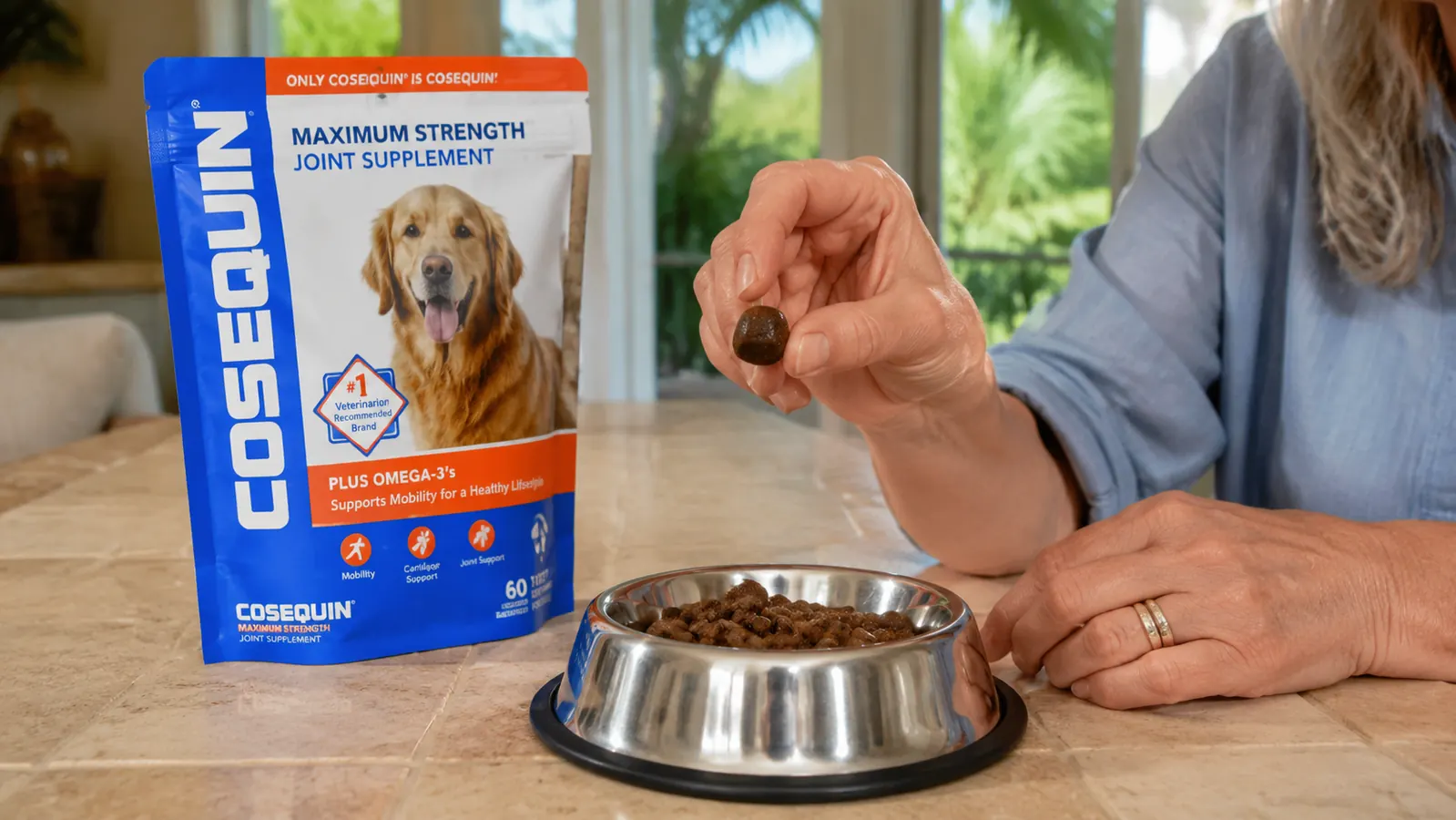
For a dog under 25 pounds, the Cosequin soft chew label recommends one chew per day for maintenance. For the initial loading phase, which Nutramax calls the Loading Dose and recommends running for four to six weeks, the dose doubles. Two chews per day for a dog Milo's size. That is the dose designed to saturate the joint tissue with glucosamine and chondroitin before scaling back. Most of the one-star reviews I read said things like 'I gave my dog one a day for a month and noticed nothing.' They skipped the loading phase. Or nobody told them it existed.
For a nine-pound dog, I also broke chews in half at first. Not because the dose required it, but because Milo was suspicious of anything new in his bowl. The soft chews are on the larger side for a very small dog, about the size of a thick gummy vitamin, and some small breeds refuse them whole or let them drop to the floor and nudge them around instead of eating them. Breaking the chew in half and pressing it into the center of his kibble solved that immediately. After two weeks he was eating them without any hiding tricks. If your dog refuses the chew whole, try that before you decide they hate the supplement.
What to Expect in the First 30 Days (Spoiler: Not Much)
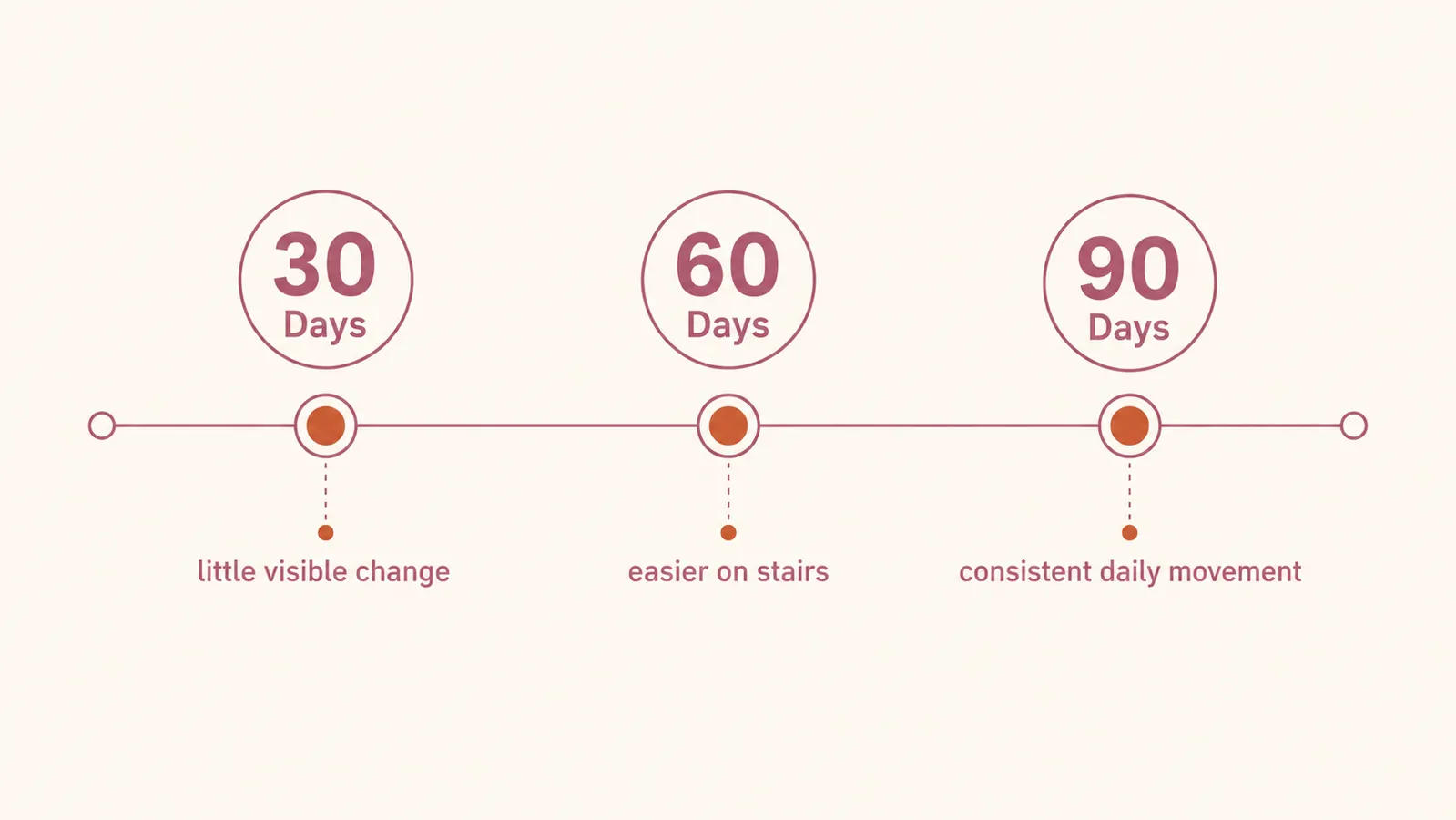
I want to say this clearly because I wish someone had said it to me: the first 30 days of Cosequin are not when you see results. They are the loading period. The glucosamine and chondroitin are absorbing into cartilage tissue. The joints are not yet benefiting from the full therapeutic concentration of the compound. If you look at your dog at day 28 and see no change, that is completely normal and does not mean the supplement is failing.
What I noticed in Milo's first month was nothing in terms of mobility. What I did notice was that he ate the chews without complaint by week two, his coat seemed a little softer, and he did not have any digestive upset, which I had worried about. Some dogs do have soft stools in the first week as their gut adjusts. Milo had none. The omega-3 component is sometimes credited for the coat improvement that owners report early on, even before joint benefits appear.
The first 30 days are the loading period. The joint tissue is absorbing the compound. Looking for mobility changes before day 45 sets you up to quit too early.
Days 30 to 60: The Window Where It Either Works or It Does Not
The second month is when you should start seeing something. For Milo, the change around day 45 was not dramatic. He did not leap onto the couch from a standing position. What happened was that he stopped hesitating at the patio steps. He still went slowly, but the pause, the thing where he would stand and stare and look uncertain, was gone. He just went up. That is the kind of change Cosequin tends to produce: a reduction in the friction around movement, not a restoration of youth.
If you are at day 60 of consistent, correctly dosed supplementation and you are seeing nothing, that is information worth bringing to your vet. It may mean the joint deterioration has progressed past the point where a glucosamine-based supplement can make a meaningful difference. It may mean your dog needs prescription anti-inflammatories, additional diagnostics, or a different approach entirely. Cosequin works best as a preventive and supportive measure. When degeneration is advanced, the cartilage support component simply has less cartilage to support.
After 90 Days: The Honest Long-Term Picture
Milo has been on Cosequin for eight months now. The patio steps are not an issue. He moves through the house more freely. He still lies down slowly, the way older dogs do when joints need careful management, but he gets up without the grunt he used to make. I would describe the result as a consistent floor being raised under his mobility, not a ceiling removed. He is not a puppy again. He is an 11-year-old with better-supported joints who moves with more confidence than he did nine months ago.
One thing nobody mentions in the reviews: you cannot stop giving it and expect the benefit to hold. This is a daily supplement, not a course. When I ran out for five days because my auto-ship order was delayed, Milo started being slow on the steps again by day four. That is how it works. The therapeutic concentration in the joint tissue has to be maintained continuously. Budget for it as a monthly line item, not a one-time experiment.
What Cosequin Cannot Replace
Here is the part of this review that matters most if your dog's situation is more serious than Milo's was. Cosequin is a joint support supplement. It is not a pain medication, not an anti-inflammatory drug, and not a substitute for veterinary evaluation when a dog is in active pain. Glucosamine and chondroitin work on cartilage tissue over time. They do not block pain pathways the way NSAIDs like Carprofen or Meloxicam do. If your dog is yelping when you touch their hips, refusing to bear weight on a limb, or showing clear signs of pain, a supplement is not the first call. The vet is.
True arthritis pain management in dogs often requires a multi-layer approach: an NSAID or other prescription pain medication to manage the inflammation and pain acutely, combined with a joint supplement like Cosequin for longer-term cartilage support, combined with environmental changes like orthopedic bedding, ramps instead of stairs, and shorter, more frequent walks. Cosequin fits best in that second layer. Asking it to do the work of the first layer is where I see owners get frustrated and write the one-star reviews.
I also want to name one more thing that supplements cannot fix: structural joint damage from old injuries, severe hip dysplasia, or ligament tears. If the imaging shows bone-on-bone contact or structural instability, that is a surgical or prescription pain management conversation, not a supplement conversation. Cosequin is a good product. It is not a miracle, and no honest review should imply otherwise.
How to Know When Cosequin Is Not Enough
Watch for these signs that it is time to call your vet rather than continue adjusting dosage or brand. Your dog is losing muscle mass around the hindquarters faster than can be explained by age alone. Your dog is vocalizing when they move or when you touch certain areas of the spine or hips. Your dog has stopped seeking out favorite spots because getting there is too hard. Your dog is increasingly reluctant to do any movement, not just stairs or jumps. Any of these is a signal that the situation has moved past what a glucosamine supplement can address on its own.
Cosequin is not a reason to delay that vet visit. It is something you can often continue alongside prescription management, but that is a conversation your vet should lead. Ask specifically about adding a joint supplement to whatever pharmaceutical protocol they recommend. Many vets are comfortable with Cosequin as an adjunct because the safety profile is good and the Nutramax research is legitimate.
Pros
- Clinically researched formula from Nutramax, not a white-label supplement with vague sourcing
- Soft chews are palatable for most small dogs once the initial newness wears off
- MSM and omega-3 addition gives anti-inflammatory support beyond basic glucosamine-chondroitin
- Clear weight-based dosing, including a distinct loading phase, which most competitors skip
- 78,000-plus owner reviews give a real-world data pool for outcomes across breeds and ages
- Safe to use long-term without liver or kidney concerns at labeled doses
Cons
- Results require 45 to 60 days of consistent use before you can fairly evaluate effectiveness
- Chews are large for very small dogs; breaking in half is necessary for some tiny breeds
- Not a pain medication; dogs in active pain need a vet, not a higher supplement dose
- Benefits disappear within a week if you stop giving it, so this is a permanent monthly cost
- Loading phase dose (double) is not clearly emphasized in the marketing, leading to underdosing
Who This Is For
Cosequin is the right supplement if your senior small-breed dog is showing early to moderate signs of joint stiffness: slower on stairs, reluctant to jump onto furniture they used to love, taking longer to lie down comfortably, or moving stiffly after a long nap. It is also worth considering as a preventive for small breeds over age seven, even before you see obvious symptoms, because cartilage support works best when there is cartilage left to support. The earlier you start, the more floor you preserve under their long-term mobility. If you want to compare it against other formulas, the comparison with Zesty Paws Mobility Bites breaks down the ingredient differences in detail. And if you are not sure whether your dog even needs glucosamine yet, the list of ten signs your senior small dog needs a supplement is a good starting point.

Who Should Skip It
If your dog is already in visible pain, limping, vocalizing, or refusing to move, this is not a substitute for veterinary care. Get a diagnosis first. Once you have a prescription pain management plan in place, you can often add Cosequin alongside it, but start with the vet, not the supplement aisle. Also skip this if you are unwilling to commit to a daily routine for at least 60 to 90 days. A 30-day trial at half the loading dose will not give you real data. Either give it a genuine run, loading phase and all, or save the money until you are ready to commit to it.
If your small dog is moving like they used to be a bigger, heavier dog than they are, Cosequin is worth a genuine three-month trial.
Nutramax Cosequin soft chews include glucosamine, chondroitin, MSM, and omega-3 in a formula backed by peer-reviewed research. More than 78,000 dog owners have left their experience. Check today's price and read the loading-phase instructions before you start.
Amazon Check Today's Price on Amazon →