

Penny arrived at my house in February 2024 shaking. Not the little tremble you see when a small dog is cold or excited. I mean full-body, can't-hold-still shaking that started the moment she heard a noise she did not recognize, which was almost every noise. She had spent four years in a puppy mill in central Florida, used as a breeding mama, never socialized, never given a reason to believe that humans were safe. She weighed 6.2 pounds and flinched when I set a mug on the counter. Getting a supplement into her at all was its own project.
I want to be honest about something before we go further. Penny is in behavioral support with a certified dog behavior consultant. She gets structured desensitization work every week. The Zesty Paws Advanced Calming Chews are not a replacement for that work, and I would not frame them as one. If your dog has severe anxiety rooted in trauma, please loop in your vet before reaching for any supplement. What I can tell you is what I observed after three months of daily use, in one specific dog, under one specific set of circumstances.
Quick Verdict
A real, modest edge off everyday reactivity for a small anxious dog. Not a fix for deep-seated trauma, but a legitimate tool in a broader support plan.
Amazon Check Today's Price →Still searching for something that takes the sharp edge off without sedating your dog? Here is where I started.
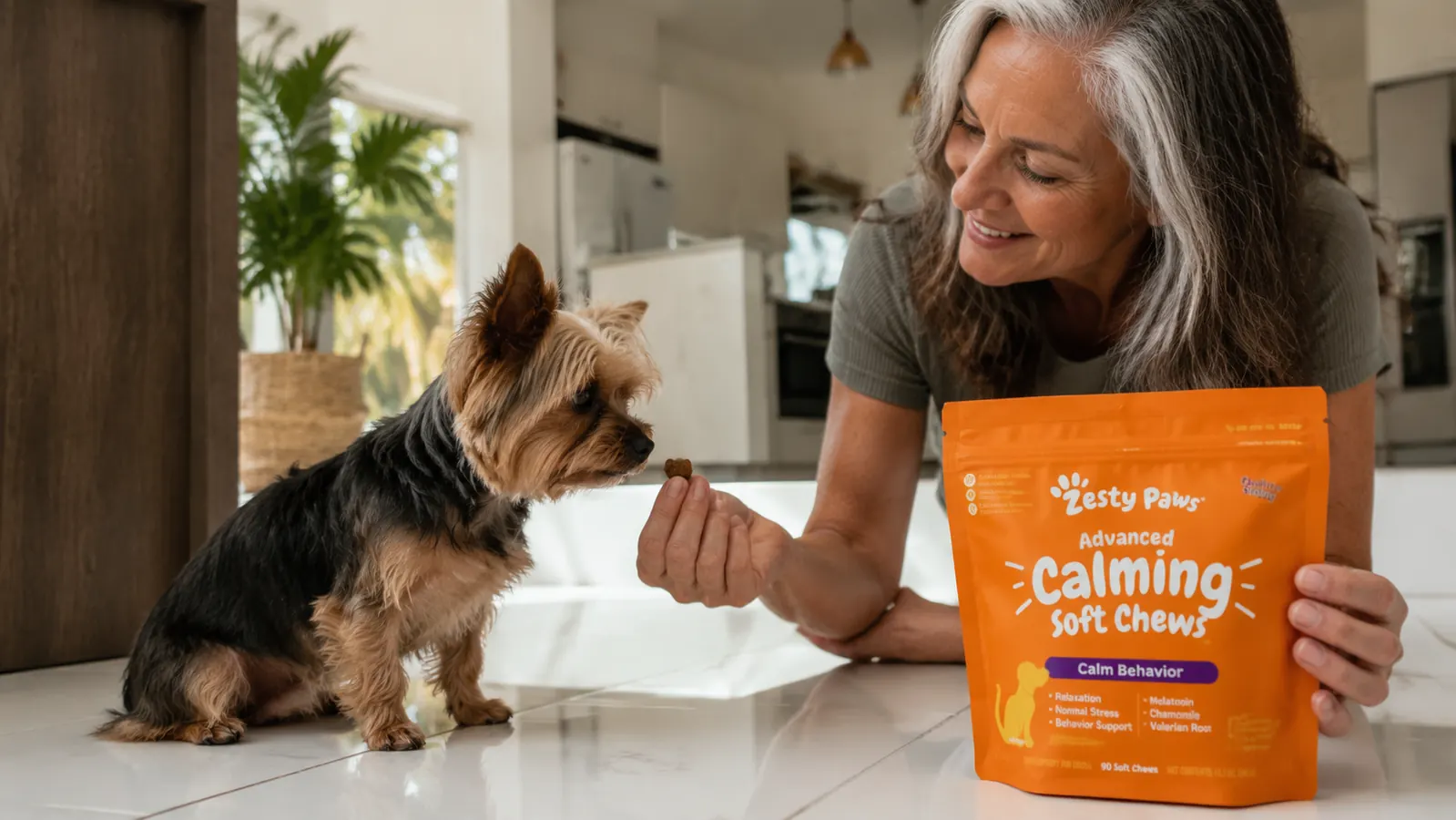
Zesty Paws Advanced Calming Soft Chews use Suntheanine L-Theanine, a patented form of the amino acid found in green tea, alongside melatonin and a proprietary blend of botanicals. They are soft, small, and can be halved for tiny mouths. They are what I reached for after reading every anxious-rescue thread on the internet for three months.
Amazon Check Today's Price on Amazon →How I Introduced the Chews to a Dog Who Mistrusted Everything
Getting Penny to eat anything from my hand took four weeks on its own. By the time I started the Zesty Paws chews, she would take treats directly from me as long as I kept my hand low and did not make eye contact while I offered them. I started with a half dose, one soft chew cut in two, tucked into the corner of her morning meal. She ate it without detecting it the first morning. By week two I was handing it to her directly.
Palatability is not a concern here. The chews smell like a duck-flavored treat and Penny, who at first refused anything that was not her regular kibble, took them readily once she decided I was not trying to poison her. Each chew is small enough that a 6-pound dog can chew through one without gulping. I did cut them in half for the first two weeks per the guidance on the label for dogs under ten pounds.
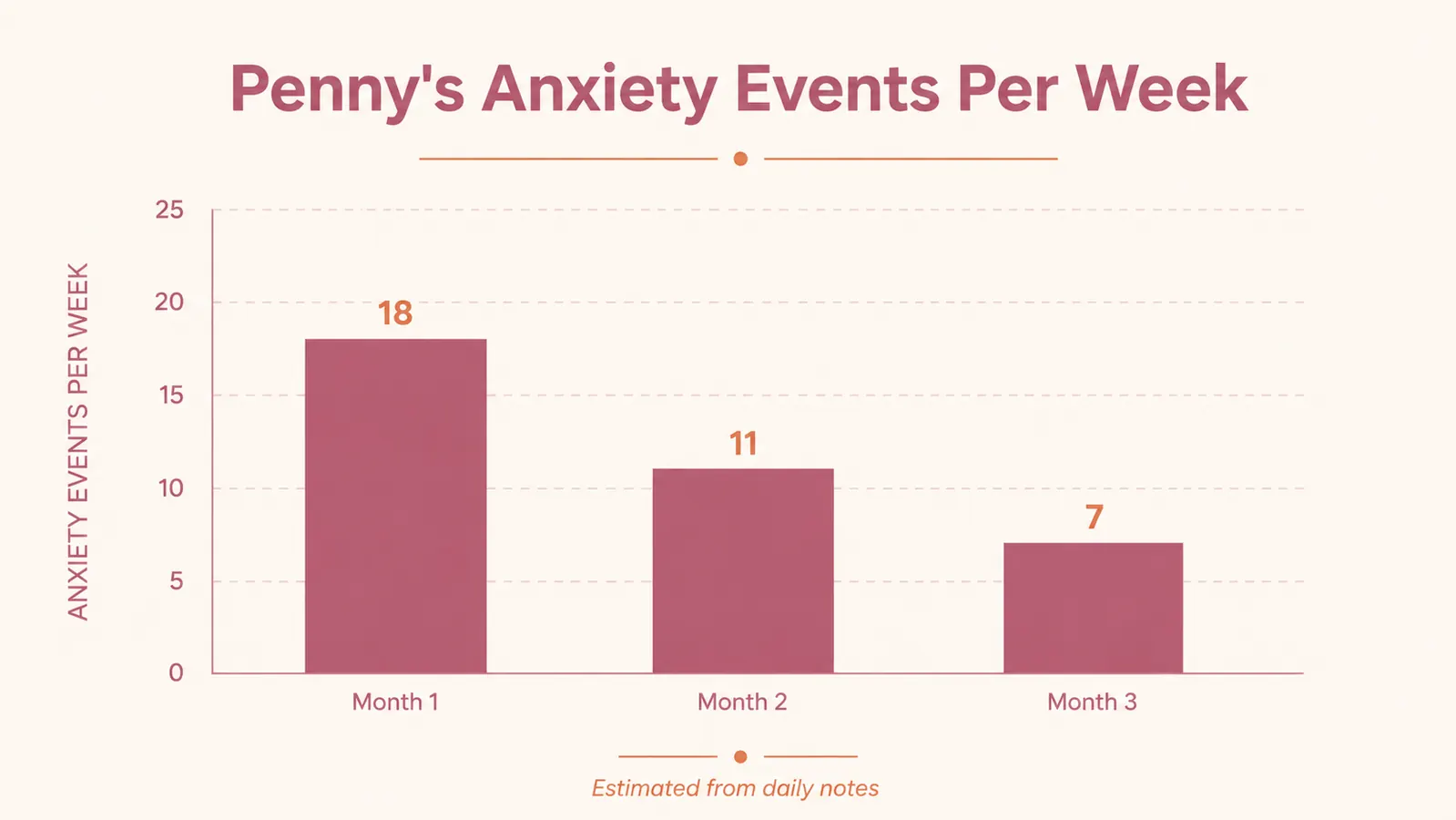
I kept a simple notes log on my phone. Every evening I jotted down the number of startle events I noticed, whether she settled in her bed within a normal window of time, and whether any specific triggers (garbage truck, doorbell, rain) caused the usual level of reaction. This is how I tracked what follows.
What the Ingredient Label Actually Says
The main active in Zesty Paws Advanced Calming is Suntheanine, which is a branded, purified form of L-Theanine produced through an enzymatic process that mimics how green tea synthesizes it. Standard L-Theanine supplements can contain a mix of isomers. Suntheanine is 99 percent L-Theanine in its pure form. There is published research in both humans and dogs suggesting L-Theanine promotes relaxation without sedation by increasing alpha brain wave activity. The effect is subtle, not chemical. That is the accurate way to frame it.
Alongside Suntheanine the formula includes melatonin (1 mg per two-chew serving), thiamine (vitamin B1), and a proprietary blend with valerian root, ginger root, and passionflower. The melatonin dose is low, which I appreciate. Some calming supplements designed for dogs use melatonin at levels that leave a small dog genuinely drowsy, and that was not what I was after. I wanted the edge off, not a sedated dog.
One thing worth noting: the supplement is manufactured by Zesty Paws in an NASC (National Animal Supplement Council) Quality Seal facility. That matters to me. It means the facility has been through a third-party audit for manufacturing practices, quality control, and labeling accuracy. It is not FDA approval, but it is a meaningful bar above random supplements with no quality markers.
What Changed in Month One
The first three weeks I noticed nothing. I want to say that clearly so nobody reads this expecting a two-week transformation. Week four was the first time I thought something might be happening. Penny still startled at the garbage truck on Tuesday mornings, but instead of trembling for fifteen minutes afterward, she settled back into her bed in about five. That is a real difference for a dog whose post-trigger recovery used to last until the next disturbance.
My behavior consultant noted the same thing at our week-five check-in. She said Penny was hitting her calm threshold faster than she had in previous sessions. She did not know I had started the supplement until I told her. That felt meaningful to me, not because it is a controlled experiment, but because she had a baseline to compare against.
Months Two and Three: Where the Results Plateaued
By month two I was tracking a consistent reduction in the number of high-intensity startle events per week. In my notes from month one, I counted somewhere between 15 and 20 noticeable reactivity spikes per week. By month two that had dropped to around ten or eleven. By the end of month three I was seeing roughly six or seven per week. That is a real improvement, but it also maps closely to the behavior work Penny was receiving in parallel, so I cannot attribute all of it to the chew. What I can say is that during a two-week stretch in month two where travel disrupted our behavior sessions, the reduced reactivity held rather than backsliding.
Her nighttime behavior showed the clearest single change. Penny used to settle into bed at around 10 PM and then reposition and whimper for 30 to 40 minutes before fully quieting. Starting around week six, that window shortened to ten to fifteen minutes most nights. Whether that is the low-dose melatonin, the L-Theanine, the accumulated behavior work, or all three together, I cannot tell you. But the change is real and it held.
She still startles at the garbage truck. But she settles back in five minutes instead of fifteen. For a puppy-mill rescue, five minutes is a big deal.
What Did Not Change
Penny still has contact sensitivity. Touch from strangers is not something a soft chew addresses, and nothing in the Zesty Paws formula is going to rewire that response. She still trembles at loud, sudden sounds. The garbage truck, a dropped pan in the kitchen, any vehicle backfiring outside, all of those still trigger her. What the supplement seems to do is compress the recovery window, not eliminate the trigger response. That is an honest and realistic framing.
I also want to flag that two dogs in the reviews I read had mild digestive upset in the first week. Penny had slightly softer stools for five days. That resolved on its own and did not recur. If your dog has a sensitive stomach, starting at half dose for the first two weeks is probably worth the patience.

How This Compares to Alternatives I Considered
Before settling on Zesty Paws I looked hard at VetriScience Composure, which is the other L-Theanine-based supplement with wide veterinary recognition. The main difference is the form: Composure comes in a bite-sized chew that is smaller and harder to split, and the L-Theanine in Composure is not the patented Suntheanine form. Some owners report stronger palatability with Composure for picky dogs. I went with Zesty Paws partly because the soft chew format is easier to cut in half for a very small dog, and partly because the NASC seal was easier to verify on the product page. If you want a deeper look at how the two stack up, I covered it in a separate comparison. See our full head-to-head in the Zesty Paws vs VetriScience Composure comparison.
I also briefly considered an Adaptil pheromone diffuser as an alternative or add-on. Pheromone diffusers work on a different mechanism entirely and are worth discussing with your vet if your dog's anxiety is severe. I use one now alongside the chews. They are not competing products.
Pros
- Suntheanine (patented L-Theanine) is the best-researched calming amino acid for dogs
- Low melatonin dose (1 mg per serving) avoids oversedation in small breeds
- Soft chew format is easy to split for dogs under ten pounds
- NASC Quality Seal means third-party manufacturing audit
- High palatability even for suspicious or picky dogs
- Noticeable reduction in post-trigger recovery time for my dog after about four weeks
Cons
- No effect on trigger response itself, only on recovery and baseline reactivity
- Takes three to four weeks before any changes are noticeable
- Mild digestive softening in week one for some dogs
- Not a substitute for behavioral intervention in dogs with trauma histories
- Proprietary blend means you cannot verify individual botanical doses
- 4.2-star average on Amazon reflects a real minority who saw no change at all
Who This Is For
Zesty Paws Advanced Calming Chews are a good fit for dogs with everyday anxiety: car rides, vet visits, thunderstorm season, separation that causes whining but not destruction. They are also a reasonable tool for rescue dogs in the early settling-in phase, used alongside patience and structured routine. They work best as part of a broader support plan, not as the whole plan. If your dog is destructive, injuring itself, or showing aggression rooted in fear, please bring your vet into the conversation before supplementing. That is not a knock on this product. It is just the honest frame for what a calming supplement can and cannot do. You can learn more about what anxiety in rescue dogs looks like in our article on 10 signs your rescue dog has anxiety.
Who Should Skip It
If your dog is on prescription anxiety medication, melatonin supplementation from an outside source may interact. That is a conversation for your vet. If your dog has zero tolerance for any treat format, including soft chews with a strong savory smell, delivery will be a challenge. And if you are expecting a supplement to do what behavioral conditioning does, this will disappoint you. It is not a sedative. It is not a medication. The category is calming support, and that is exactly what it offers, nothing more dramatic.
Three months in, I still give Penny one chew with her morning meal every single day. It is part of the routine.
If you have an anxious small dog and you are looking for a place to start that is lower-stakes than prescription medication, Zesty Paws Advanced Calming Chews are worth the trial. Give it six weeks before you judge the results. Check the current price on Amazon and look at the recent reviews. The ones that say nothing worked are often dogs with severe anxiety who needed vet-directed care. The ones that sound like mine are everyday anxiety in everyday dogs.
Amazon Check Today's Price on Amazon →