

I switched my Yorkie, Penny, from a collar to a step-in harness about three years ago. Penny is a former puppy-mill mama, eight pounds, and she has a trachea that sounds like a squeaky hinge if she pulls on a leash even a little. Her vet mentioned it during her second checkup with me, almost as an aside. "Small breeds and tracheal pressure," she said. "Worth thinking about." That was enough for me. Within a week I had donated four collars and started a new routine at the front door.
If you own a small dog and you are still walking on a collar, I am not here to make you feel bad about it. Most of us start there because that is what we knew. But the reasons to switch to a soft step-in harness are piling up, and most of them take about thirty seconds to understand once someone lays them out clearly. So here are the ten that convinced me and the small-dog owners I have talked to over the years.
Your small dog's trachea cannot speak for itself. The EcoBark step-in harness can.
The EcoBark soft mesh step-in harness is designed specifically for XXS, XS, and small breeds. No over-the-head fuss, no hard buckles against the ribcage, and no tracheal pressure. Rated 4.6 stars by more than 11,000 small-dog owners.
Amazon Check Today's Price on Amazon →Collars compress the trachea. Small breeds are built differently.
A large Labrador can take a tug on a collar without much consequence. The same tug on a six-pound Chihuahua or a Yorkshire Terrier puts direct pressure on a trachea that is already proportionally smaller and more delicate. Toy breeds are especially prone to tracheal collapse, and repeated collar pressure can aggravate the tissue over time. A soft step-in harness moves the attachment point to the back, distributing force across the chest and shoulders instead. The trachea is completely out of the equation.
Amazon See the EcoBark Step-In Harness on Amazon →Small dogs are champion escape artists when they panic.
If a loud truck, a big dog, or a sudden noise spooks a small dog on a collar, the natural reaction is to back up and duck. And a frightened small dog can slide right out of a standard collar in under a second. That split-second slip is one of the most common ways small dogs get loose near traffic. A properly fitted step-in harness wraps around the torso with two secure points of contact. There is nowhere to back out of it. The EcoBark's adjustable chest and belly straps let you get a snug fit without restricting breathing, which means Penny stays with me no matter what spooks her.
Amazon Check the EcoBark Harness on Amazon →Anxious and rescue dogs dread anything going over their heads.
Penny took six weeks before she would let me touch her ears. Anything coming toward her face or over her head sent her flat to the floor. Traditional step-over harnesses and back-clip vests that pull over the snout were completely off the table for her. A step-in harness goes on from below. You lay it flat on the floor, your dog walks into it, and you lift the sides and click them closed. Penny figured out that process in about four days and now walks to the harness herself at the front door. For a dog who came from trauma, that is not a small thing.
Amazon See the EcoBark Step-In Harness on Amazon →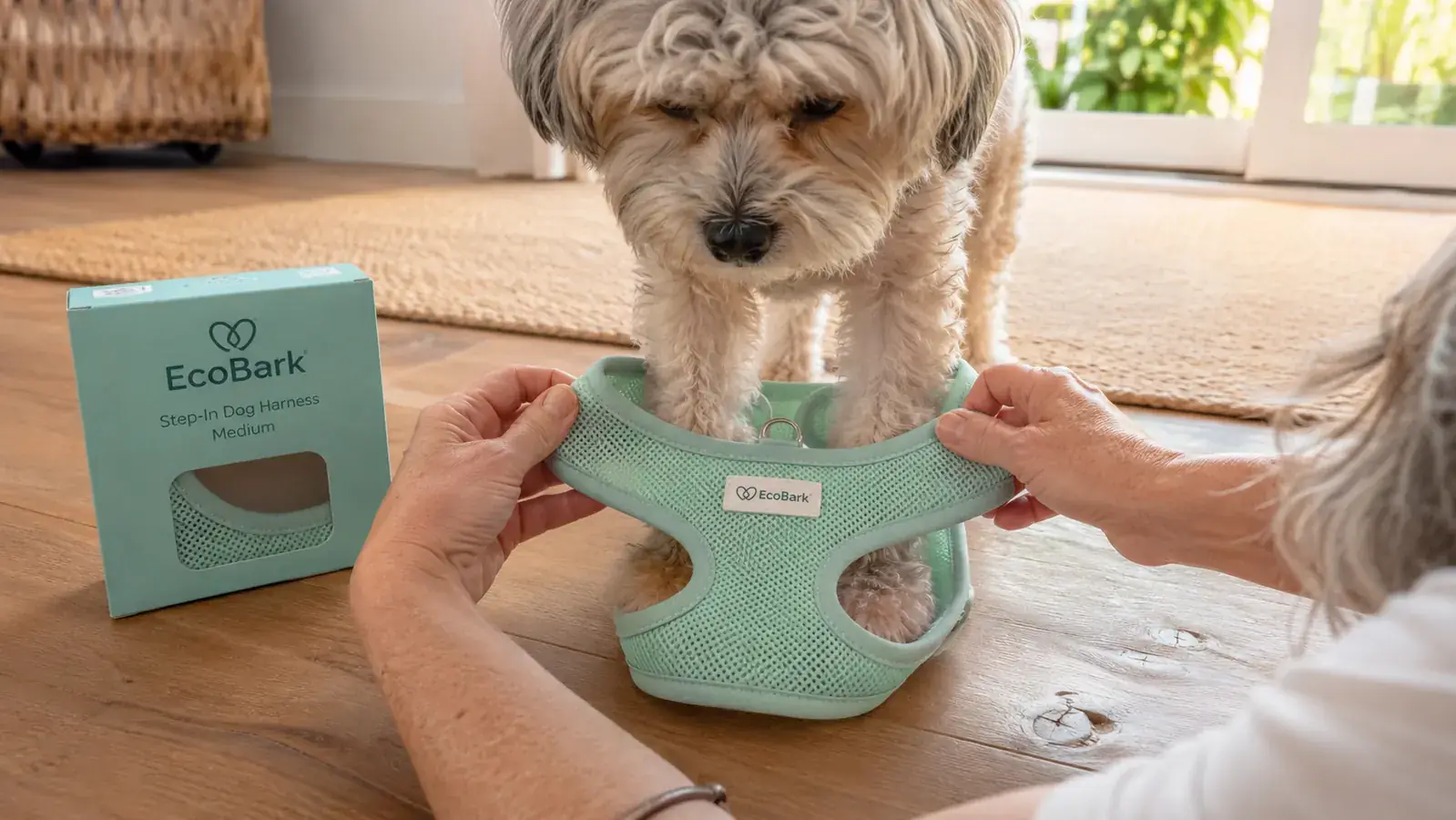
Coughing and gagging on walks is not normal. It is a warning sign.
If your small dog makes a honking or gagging sound during walks, especially after pulling on the leash, that is often the trachea under pressure. Many owners hear it and assume it is just a quirk. It is not. It is a dog's trachea being squeezed. Switching to a step-in harness takes the leash attachment point off the neck entirely. Most dogs who cough or gag on collar-walks stop within a few days of switching to a back-clip harness. If the coughing continues after the switch, that is a vet conversation, but for most small dogs, the collar is the culprit.
Amazon Check the EcoBark Harness on Amazon →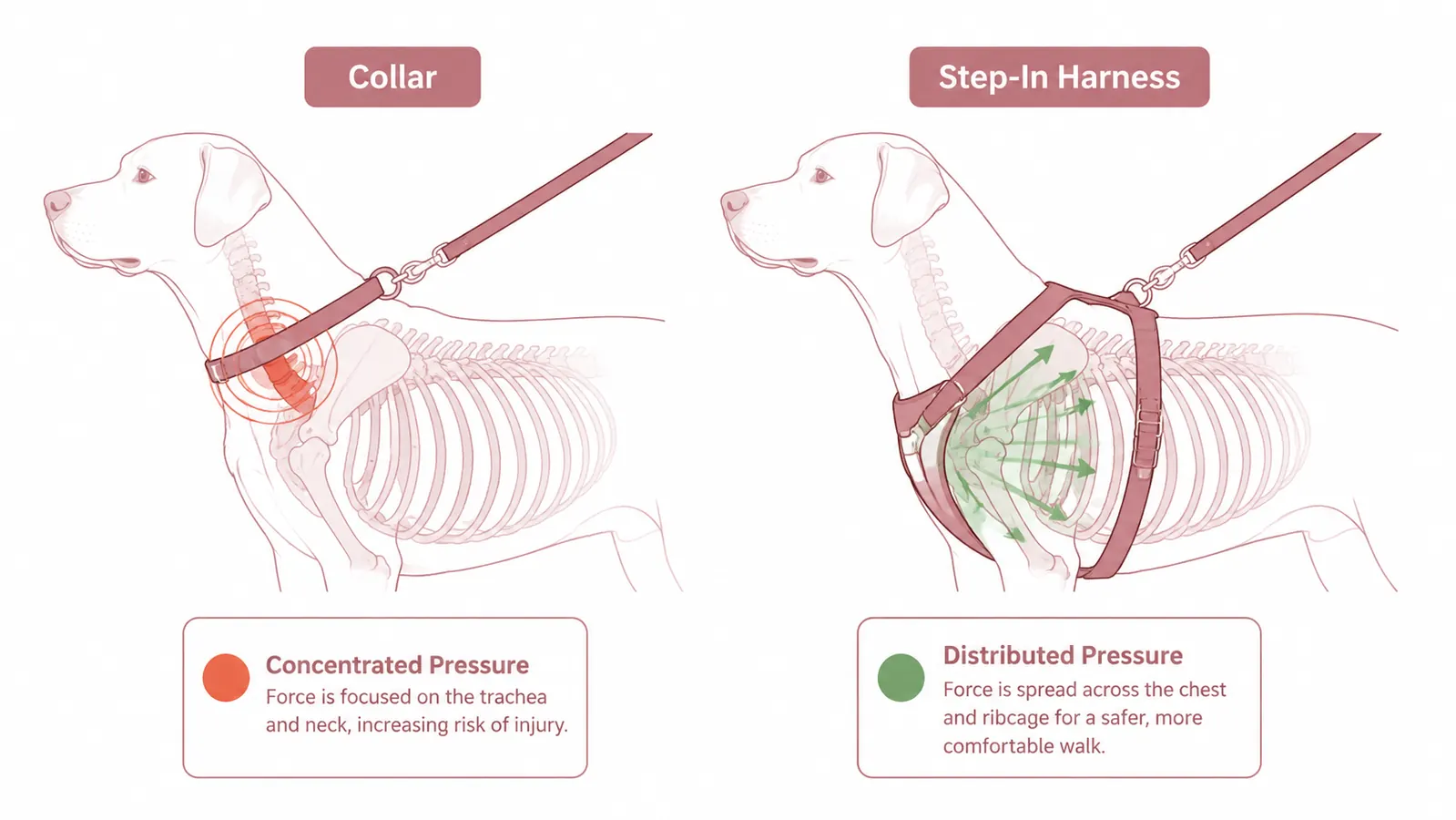
A harness gives you better control without brute force.
On a collar, all your steering leverage runs through a single strap at the neck. On a step-in harness, you are connected to the widest part of your dog's torso. That means you can guide a lunging or reactive small dog without yanking their neck sideways. For tiny breeds who want to charge at a squirrel three times their size, that torso connection lets you redirect them smoothly. Less force, more control. Your wrist and shoulder will notice the difference too.
Amazon See the EcoBark Step-In Harness on Amazon →Soft mesh does not mat the coat the way a collar does.
Long-coated small breeds, including Yorkies, Maltese, Shih Tzus, and Pomeranians, develop collar rubs at the base of the neck. You can see it in the coat: a ring of friction damage where the fur breaks and mats in a circle. A soft mesh step-in harness, worn correctly, sits on a broader area and distributes pressure so evenly that most long-coated dogs show no coat damage at all. The EcoBark uses an eco-friendly soft mesh that I would describe as the dog equivalent of athletic jersey fabric. It breathes in the South Florida heat and does not grab the coat the way a woven or nylon strap does.
Amazon Check the EcoBark Harness on Amazon →Penny figured out the step-in routine in four days and now walks to her harness at the front door. For a dog who came from a puppy mill, that kind of calm trust is not a small thing.
Senior small dogs have less tolerance for neck pressure as they age.
Dogs who spent years on a collar can develop sensitivity in the neck and cervical spine as they get older. Arthritis, soft tissue changes, and general wear add up. A senior small dog pulling into a collar on a walk is loading that aging cervical tissue every single time. Moving to a step-in harness at any age is good practice, but for dogs over seven or eight, it is especially kind. The chest and shoulder attachment puts stress on tissues that are built to handle it.
Amazon See the EcoBark Step-In Harness on Amazon →Step-in harnesses are easier to put on than most harnesses, not harder.
The argument I hear most often for sticking with a collar is convenience. Clips are fast, and harnesses look complicated. But a step-in harness is genuinely simple once you have done it a few times. Lay it flat. Dog walks in. Lift the sides. Click the chest clip. Done. The EcoBark has two adjustment points with slide buckles that stay set once you find the right fit, so each morning it is a four-second routine. Collars have that one advantage of slipping on over the head in two seconds, but step-in harnesses are close enough that convenience is no longer the deciding factor.
Amazon Check the EcoBark Harness on Amazon →Small dogs in harnesses read calmer to other dogs on walks.
This one surprises people. Dogs communicate through body posture, and a dog walking with tension around the neck often carries a stiffer, more reactive posture. A dog in a comfortable harness, walking without any pressure point at the throat, often moves more loosely and naturally. Loose, relaxed movement signals less threat to oncoming dogs. That is not a guarantee of peaceful encounters, but multiple trainers and dog behaviorists have noted that harness-walked dogs tend to present as less guarded in their body language. Fewer tense greetings. Fewer reactive flare-ups.
Amazon See the EcoBark Step-In Harness on Amazon →It is one of the lowest-cost safety upgrades you can make for your small dog.
A quality soft step-in harness for a small breed costs less than a single vet co-pay. The EcoBark step-in harness is one of the top-rated options specifically designed for XXS, XS, and small dogs, with over 11,000 reviews and a 4.6-star average. Compare that to what one visit about a tracheal issue, a coat mat requiring grooming repair, or a lost-dog recovery effort might cost you. The harness is not a luxury product. For small and toy breeds, it is basic equipment that most owners come to wonder how they walked without.
Amazon Check Today's Price on Amazon →
What I'd Skip
Not every harness marketed for small dogs is worth your time. Avoid hard-shell or rigid-frame harnesses that do not flex with your dog's movement. Some no-pull front-clip harnesses are also poorly suited for very small breeds because the clip sits on the sternum and can create its own pressure point on a narrow chest. Wide, rigid chest plates are uncomfortable for tiny dogs even when the size is technically correct. Stick with soft mesh and adjustable step-in designs made for small-breed proportions, not scaled-down versions of large-dog gear. And skip any harness that requires pulling a strap over your dog's face if you have an anxious or reactive dog. The whole point is to remove that stress from the routine.
The harness is not a luxury. For a small dog with a vulnerable trachea and a talent for slipping collars, it is basic equipment.
Ready to take the collar off for good? The EcoBark step-in harness is where most small-dog owners start.
Adjustable for XXS through small breeds, soft eco-friendly mesh, back-clip design, and a step-in fit that anxious dogs actually tolerate. Over 11,000 reviews and 4.6 stars. Check the current price before the size you need sells out.
Amazon Check Today's Price on Amazon →