
If you have a reactive small dog, you already know the pattern. The walk starts fine. She trots beside you, nose down, taking in the morning. Then a neighbor's Lab appears from behind a parked car, or a bicycle rolls past, or a child runs out a front door, and within a second your calm little dog has turned into something else entirely: spinning, lunging, barking, possibly trying to slip backward out of whatever she is wearing. The leash goes tight. Your heart rate goes up. And the walk ends the same way it always does, with you both heading home faster than you planned and your dog's nervous system still running hot.
I walked my rescue Yorkie, Penny, like that for months before I understood what I was doing wrong. Not just the harness, though that was part of it. The routes I chose, the body language I was carrying, the way I tensed the leash the moment I saw another dog coming were all making things worse. Reactivity in small dogs is not stubbornness. It is anxiety that has been allowed to reach full volume. The fix is not a stronger correction, it is a slower approach. This guide is everything I learned the patient way, organized into the steps I wish someone had handed me at the beginning.
Start with equipment that will not make a reactive dog more anxious to wear.
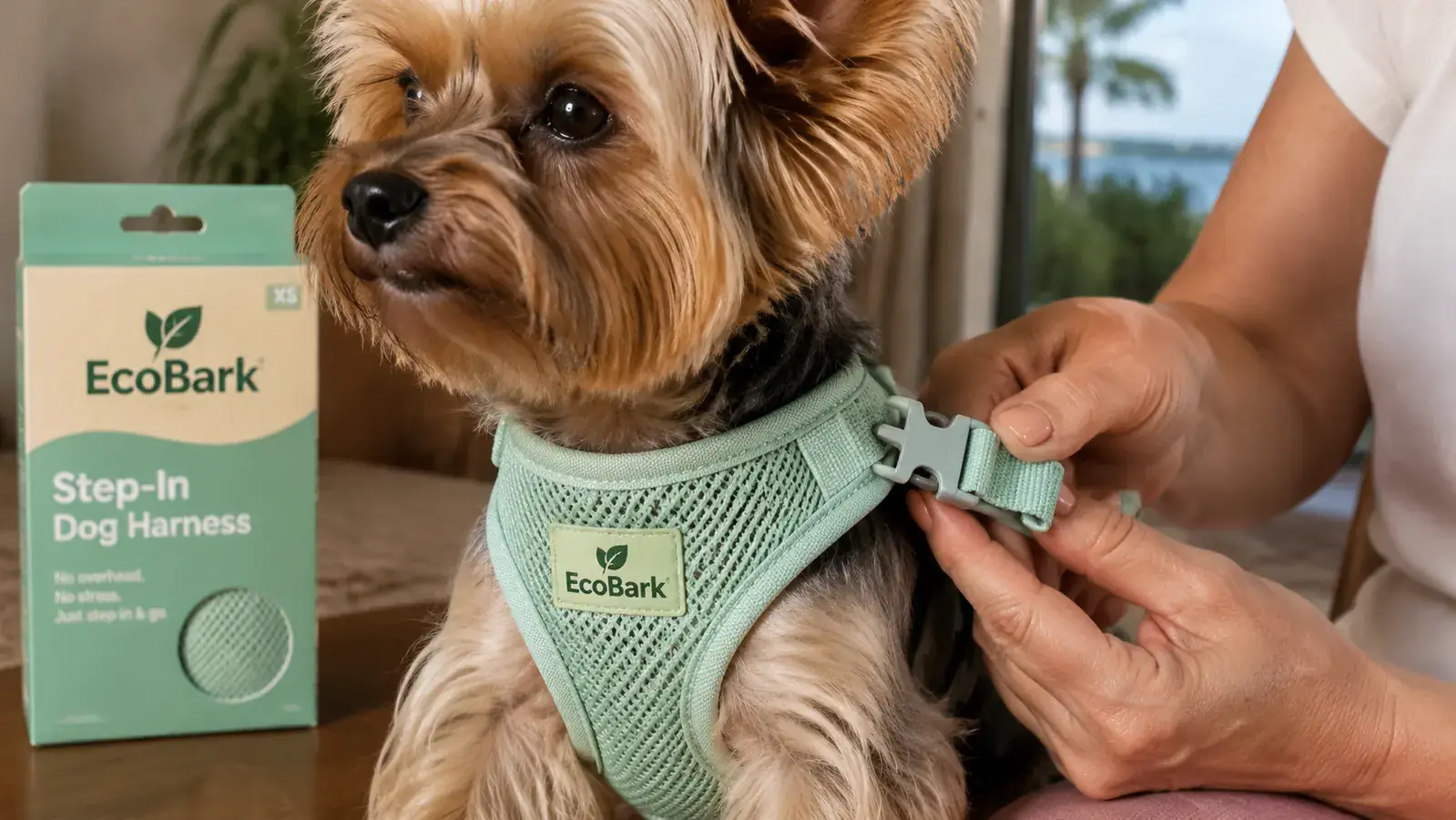
The EcoBark Step-In Harness is the harness I switched Penny to and the one I recommend to everyone dealing with a small reactive breed. It goes on from the ground up so nothing passes over her head, the mesh is soft enough that she barely notices it, and at this price point you have nothing to lose trying it.
Amazon Check Today's Price on Amazon →Step 1: Get the Harness Right Before You Go Anywhere
A reactive dog who is also uncomfortable in her harness is fighting two battles at once. Before you work on the walk itself, you need a harness she can relax in. The criteria for a reactive small dog are specific: nothing that goes over the head (that alone can spike anxiety in a dog who is already fearful), soft mesh against the body rather than stiff webbing, and a fit that is snug without restricting shoulder movement. A harness that pinches the chest or chafes under the legs will add to her tension before she even makes it to the sidewalk.
The EcoBark Step-In Harness checks all three. It is a ground-up design, meaning the dog steps her front legs into two loops and you lift the harness and clip the buckle at her back rather than pulling anything over her face or ears. The mesh is soft enough that most dogs forget they are wearing it within a minute. I put Penny in it for the first time on a Thursday afternoon and she walked across the living room without the stiff-legged freeze she had always shown in her old vest harness. That alone told me something.
Fit check: you should be able to slide two fingers under any strap, but no more. The ring at the back where the leash attaches should sit between the shoulder blades, not at the base of the neck. If the ring rides up toward the collar, size up. Most Yorkies and small Shih Tzus fall into the XXS or XS range; the EcoBark sizing chart is accurate, so measure your dog's chest girth before ordering rather than guessing by weight.
Step 2: Introduce the Harness Indoors First, With No Agenda
A reactive dog who associates the harness with the stress of walks will start showing anxiety the moment the harness comes off the hook. Break that association before it forms. For the first few days, put the harness on inside the house and just let her wear it while nothing is happening. Feed her breakfast in it. Sit on the couch and let her nap in it. Take it off after twenty minutes and put it away. The message you are sending is that this is neutral, not a signal that something overwhelming is about to happen.
Some dogs, especially former puppy-mill dogs or dogs with a history of handling anxiety, need this stage longer than you think. Penny needed four full days of harness-on-nothing-happens before she stopped lip-licking when I reached for it. If your dog is showing tension during this phase, slow down rather than pushing through. Patience here saves weeks of struggle later.
Step 3: Learn to Read the Early Warning Signs Before the Bark
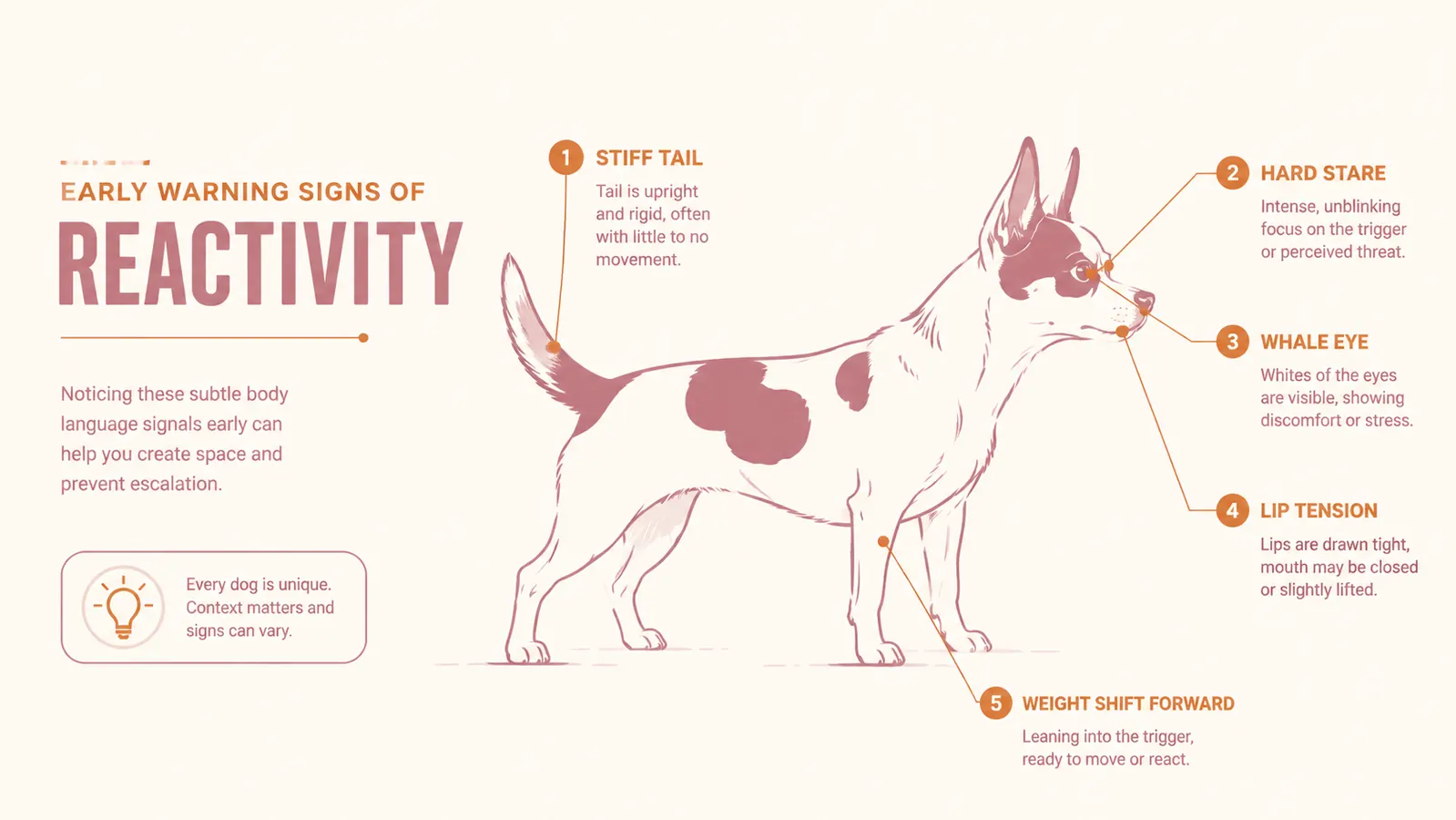
Most people think reactive dogs explode without warning. They do not. There is almost always a 2 to 4 second window between the first sign of arousal and the full bark-and-lunge response, and if you can learn to see that window, you can interrupt the cycle before it completes. The early signs are subtle because we are looking at a small dog whose body language is compressed into a very short frame: a slight stiffening of the body, the weight shifting forward, the ears going up and slightly forward, the tail going still rather than wagging, a hardening around the eye that trainers call whale eye. A hard stare toward the trigger is often the last signal before the bark.
You are not trying to stop her from noticing the trigger. You are trying to keep her brain below the threshold where noticing becomes spiraling. That line is different for every dog, and you learn where it is by watching her body, not by waiting for the bark.
Practice watching her body when she is relaxed so you know what her neutral looks like. Penny's neutral walk posture is tail in a soft curl, ears half-folded, stride loose and slightly bouncy. When I see the tail go flat and the ears pin forward, I know we have about three seconds before she has decided the stimulus is a threat. That is when I act, not after the bark starts.
Step 4: Start With Routes Too Short to Fail
The mistake most people make with reactive dogs is choosing routes that match the distance they want to walk rather than the distance their dog can handle at this stage of training. A reactive dog is not failing at walking; she is failing at emotional regulation under stress, and you cannot build that capacity by flooding her with stressors. Start with routes you know she can finish without going over threshold.
For Penny, that first route was the driveway. We walked to the end of the driveway, she sniffed the mailbox post, we turned around and came back. That was it. We did that same route for five days until she could stand at the end of the driveway and watch a car go by without stiffening. Then we added half a block. Then a full block with a turn. The route grew as her capacity grew, never faster. This is the part nobody wants to do because it feels too slow. It is not. It is the only part that works.
When choosing routes, prefer quieter streets over main roads, early morning or evening over midday (fewer dogs out and lower ambient stimulation), and paths where you can see triggers coming from a distance rather than having them appear suddenly from around corners. Predictability lowers a reactive dog's baseline arousal. She can handle more when she is not already on edge from a series of surprises.
Step 5: Manage the Leash and Your Own Body Language
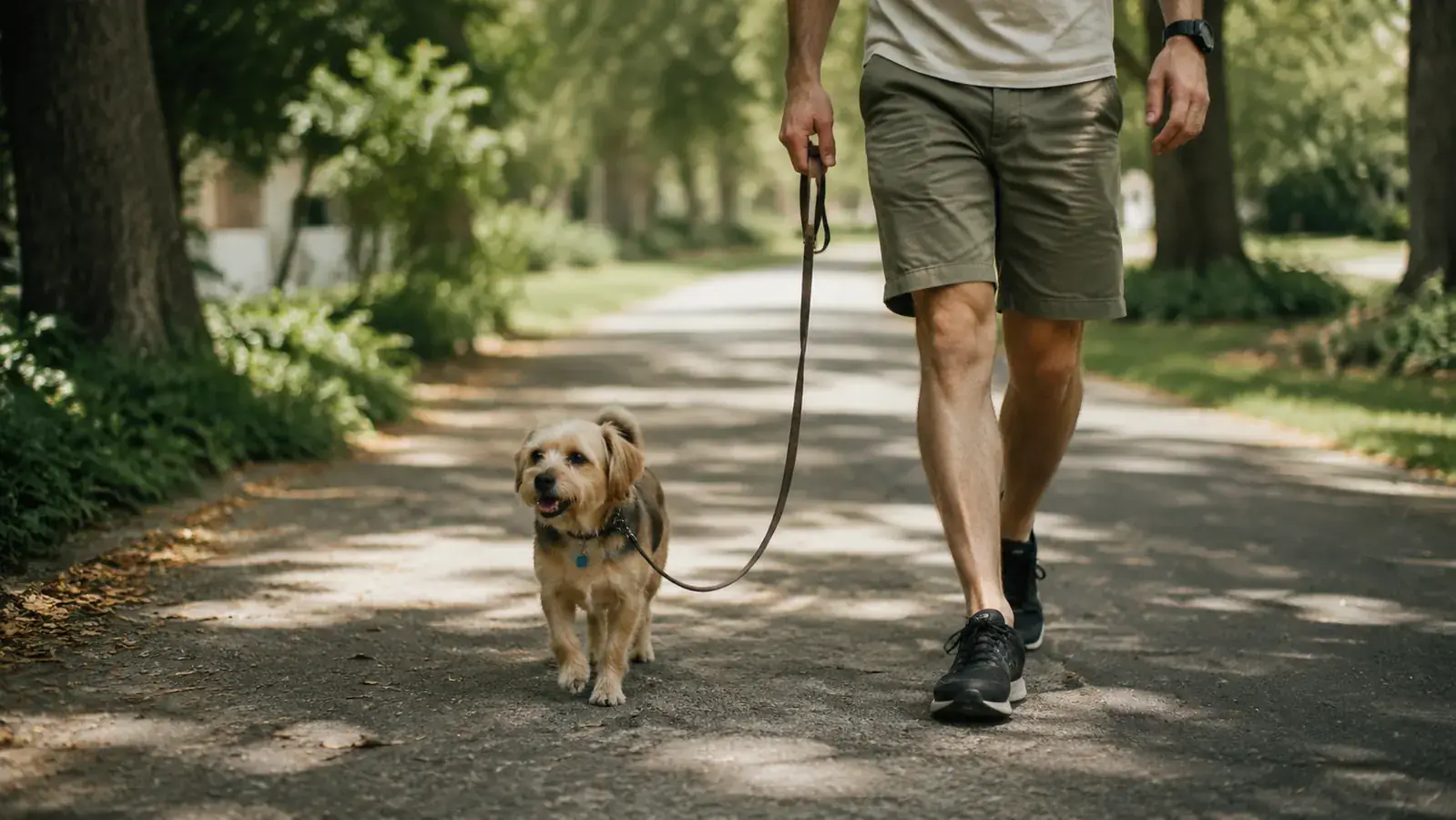
A tight leash communicates danger. When you see a trigger and grip the leash or shorten it up, you are physically signaling to your dog through the leash that her fear is correct. It is an instinct to hold on tight when you know a reaction is coming, and it is one of the hardest habits to break, but it makes everything worse. The goal is to keep a J-shaped loop in the leash at all times, even when you are anxious yourself.
The EcoBark harness helps here because the back-clip attachment distributes leash pressure across the dog's chest and back rather than concentrating it at the throat. When a collar-and-leash combo tightens at the throat during a reaction, it can trigger a panic response in anxious dogs that amplifies the reactivity. A harness with a back clip means even a tight leash moment is less likely to escalate. That said, do not rely on the equipment to do the management for you. Work on keeping the leash loose.
Your own body language matters more than most guides will tell you. Dogs read human posture, breathing, and direction of gaze constantly. If you see a dog coming and you slow down, stiffen, and stare at the approaching dog, you are telling your dog that something worth worrying about is coming. Instead, when you spot a trigger: keep your pace, look slightly away from the trigger rather than directly at it, soften your shoulders, and breathe out deliberately. It feels strange the first few times. It works.
What Else Helps
A few things that have made a consistent difference for Penny beyond the steps above. High-value treats kept in an easy-to-reach pocket, specifically something with a strong smell like small pieces of real chicken or cheese rather than dry kibble. When she spots a trigger and looks at me instead of lunging, that gets rewarded immediately. The harness has made enough of a physical difference that I now link to the full review if anyone asks me what I put her in: I have a detailed breakdown of the EcoBark Step-In after four months of daily use in our round-up of small-dog harness options.
If your dog has a particularly strong history of reactivity, especially if she was under-socialized during her critical window (as many former puppy-mill dogs were), it is worth talking to a certified separation anxiety trainer or a veterinary behaviorist. Reactivity with a traumatic history behind it sometimes needs professional behavioral support alongside the management steps above. A calming supplement may also take some of the baseline edge off on high-stimulation days, which lets the training steps land better. None of those things replace the foundation work, but they can make the foundation work easier to build.
If you want to understand why the harness choice matters so much for anxious small breeds specifically, the article on why small dogs need a step-in harness over a collar goes deeper on the trachea pressure issue and the proprioceptive effect of different harness designs on an anxious dog's nervous system. It is worth reading before you buy.
A reactive walk that ends without a meltdown is a win. It does not have to be a perfect walk. It has to be a walk that keeps her below threshold long enough for her to learn that the world outside is survivable. That belief builds slowly, one short route at a time.
If you are still using a slip collar or over-the-head vest with a reactive dog, the harness is the easiest piece to fix today.
The EcoBark Step-In Harness is specifically designed for the kind of sensitive small breeds who go tense the moment anything passes near their face. Soft mesh, step-in design, back-clip attachment, under $17. It is the change I wish I had made six months earlier with Penny.
Amazon Check Today's Price on Amazon →