

If your small dog has ever planted all four paws and refused to let anything go over her head, you already know why step-in harnesses exist. My rescue Yorkie, Penny, came to me from a puppy mill and had spent years being grabbed and handled roughly. Anything approaching her face from above made her flinch and back away. So over-the-head harnesses were simply not on the table. When I started looking at step-in options, two names kept coming up together: EcoBark and Rabbitgoo. Both are soft mesh, both hover around the same price, and both have reviews numbering in the thousands. I have spent real time with the EcoBark on Penny, and I have handled the Rabbitgoo enough to give you an honest comparison. The short answer is that for a nervous small dog under 15 pounds, they are not equally good, and the differences are exactly where it matters most.
This is a comparison built for one specific kind of dog owner: someone with a small, wiggly, anxious, or rescue-background dog who needs a harness that goes on without a fight and fits snugly enough that the dog cannot back out of it when startled. If that is your situation, keep reading.
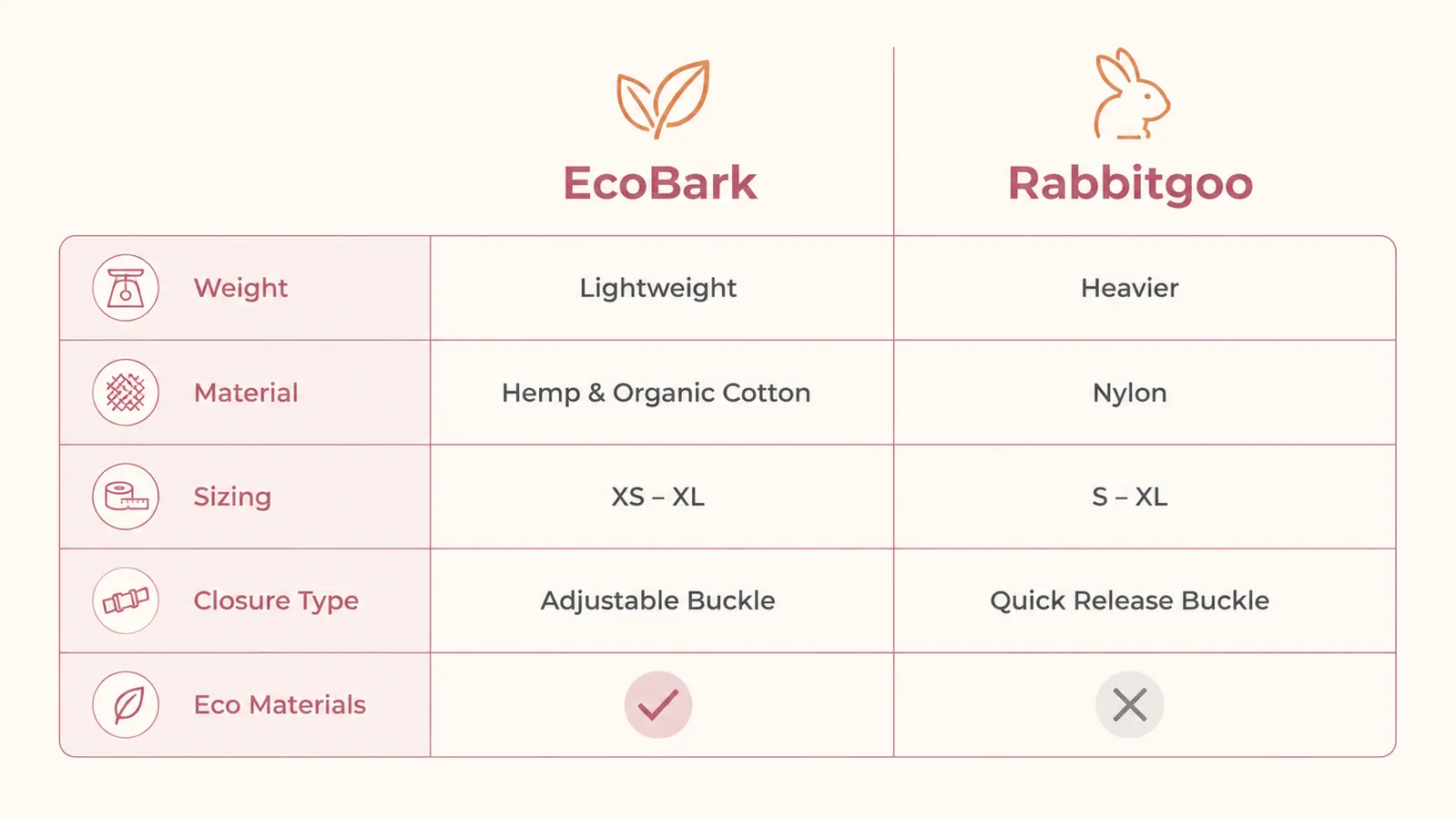
| Price (current) | ~$17 | ~$16 |
| Material | Soft recycled mesh, padded chest panel | Standard polyester mesh, minimal padding |
| Sizes for under-15-lb dogs | XXS, XS, Small (excellent granularity) | XS, S (less granularity at low end) |
| Closure type | Two side-release buckles | One back buckle, one chest buckle |
| Step-in design | True flat step-in, both legs in at once | Step-in with chest loop, slight over-body pass required |
| Weight (harness alone) | Approx. 1.8 oz (XS) | Approx. 2.3 oz (XS) |
| Eco-friendly materials | Yes, recycled fibers | No stated eco claim |
| D-ring placement | Back, well-centered | Back, offset slightly toward neck |
| Rating (Amazon) | 4.6 / 5 (11,000+ reviews) | 4.4 / 5 (very high volume) |
| Escape resistance for anxious dogs | High, wraps the chest fully | Moderate, depends heavily on correct sizing |
Where the EcoBark Step-In Wins
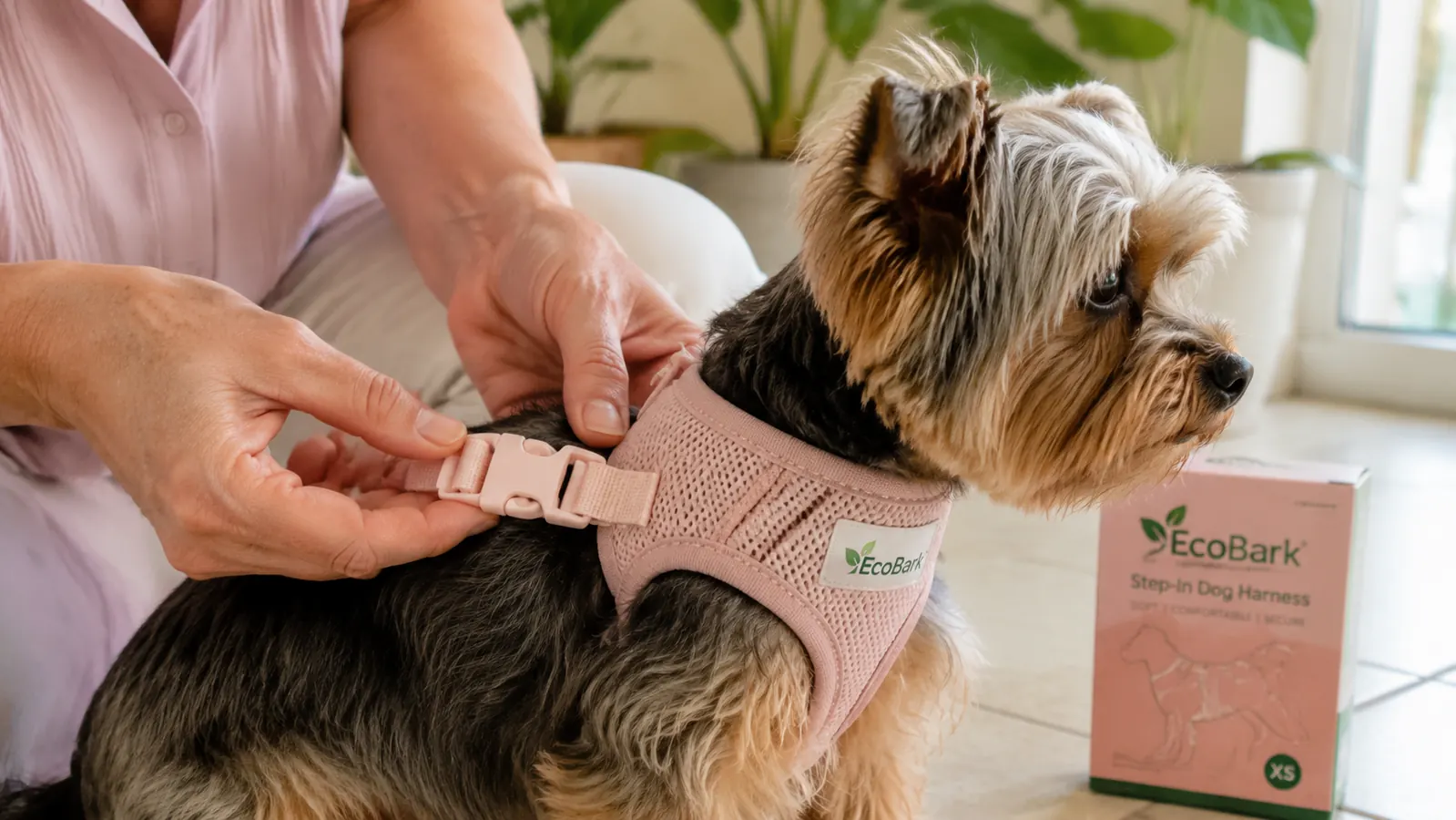
The biggest win for EcoBark is the way the harness goes on. It lays completely flat on the floor, your dog steps in with both front legs, and you lift the two sides up and snap the buckles closed at her shoulders. There is no moment where the harness has to travel over or near her head. For a dog like Penny, who treats anything near her face as a threat, that single design choice made adoption of the harness almost frictionless. Within three walks, she was stepping into it herself when I held it open on the ground. That transition took weeks with the slip-over harnesses I had tried before.
The sizing granularity at the small end of the chart is genuinely useful. The XXS fits dogs around 4 to 6 pounds, which is the weight range where most small-harness sizing completely falls apart. Penny is 8 pounds and fits the XS with room to adjust without any loose areas a determined dog could wriggle through. The chest panel is padded lightly, not thickly, which matters in a South Florida summer. A heavily padded harness turns into a sauna wrap within 10 minutes of walking in August heat. The EcoBark breathes. The recycled mesh is also notably soft against bare-bellied or thin-coated dogs. Yorkies have delicate skin and almost no undercoat to speak of. After four months of daily walks, I have not seen any rubbing marks on Penny's chest or armpits, which is not something I can say about every harness I have owned.
The two side-release buckles are another practical advantage. Each buckle closes with a firm click that you can feel and hear, and it takes deliberate pressure to release, which means a panicked dog backing away from a sound is not going to pop it open. I have tested this informally more times than I would like, because Penny still bolts occasionally at the sound of motorcycles. The harness has never come undone in a panic-back situation. That reliability is worth a lot when you are walking a dog who still has occasional flight responses.
Your nervous small dog does not need to tolerate harness-time. She can actually look forward to it.
The EcoBark step-in goes on without any over-the-head moment, buckles securely at both sides, and comes in XXS through Small for dogs 4 to 20 pounds. It is one of the few harnesses that actually gets easier to put on over time, because even anxious dogs learn to step in on their own.
Amazon Check Today's Price on Amazon →Where the Rabbitgoo Wins
The Rabbitgoo is not a bad harness. For a calm, cooperative small dog with no anxiety history, it does the job at a price that is essentially identical to the EcoBark. Its mesh is sturdy and the color selection tends to be wider, which matters to the dog owner who cares about the aesthetic of the whole walking kit. The Rabbitgoo also has a front D-ring option on some configurations, which is useful if you are working with a dog that pulls or lunges, since a front-clip redirects rather than just tightening.
If your dog has no head-phobia and no strong escape instinct, and you want something colorful and widely available, the Rabbitgoo is a reasonable choice. The problem is that the design requires the dog to pass slightly through a chest loop during the step-in process, which for some dogs reads as an over-the-head moment even though it technically is not. Calm, food-motivated dogs handle this without much fuss. Anxious dogs with a history of restraint aversion can treat that chest-loop pass as the moment they decide to bail.
For a calm small dog, the Rabbitgoo is fine. For a nervous rescue, the EcoBark's true flat step-in design removes the one moment that causes most anxious dogs to shut down.
The Step-In Design Difference: Why It Matters for Rescue Dogs
I want to spend a moment on this because I think it is undersold in most harness comparisons. The term "step-in" gets applied to two meaningfully different harness designs. The first type, which I would call a true step-in, lays completely flat. The dog places both front paws into two loops, you lift the harness up against the belly and chest, and you close the buckles. The harness never goes anywhere near the dog's face or head. The second type, which some brands market as step-in, requires the dog to step through a front chest opening that then gets pulled up and over the chest before the back is buckled. That motion, even when it avoids the head entirely, mimics enough of the over-the-head gesture to trigger head-shy and restraint-averse dogs.
The EcoBark is the first type. The Rabbitgoo leans toward the second. For a dog with no history of rough handling, this distinction barely matters. For a rescue dog who freezes or backs away the moment a hand or object moves toward her face, this distinction is everything. I spent two weeks trying different fitting approaches with a friend's dog, a former stray Maltese named Boo who was solidly head-shy. The EcoBark went on without drama on day three. The Rabbitgoo required a multi-week counter-conditioning protocol before Boo would tolerate it. That is not a knock on the Rabbitgoo's quality, but it is an honest account of what the design means for a specific kind of dog.
Sizing for Tiny Dogs: Where Rabbitgoo Starts to Fall Short
The under-10-pound dog is a harness designer's challenge. Dogs in the 5-to-9-pound range need a harness that closes very small at the chest and girth, but also adjusts through enough range to accommodate the natural variation between a 5-pound Chihuahua mix and a thick-bodied 9-pound Shih Tzu. The Rabbitgoo's XS tends to run slightly large for dogs at the very bottom of that range. The adjustment straps can compensate somewhat, but when a harness does not close small enough at the chest, the dog can back right out of it by reversing direction and tucking her head down. I have seen this happen on the Rabbitgoo with a 6-pound dog whose nervous behavior made her a committed backer-outer.
The EcoBark's XXS genuinely fits dogs that small. The two side buckles pull the harness snug against the body on both sides, rather than relying on a single back adjustment, which distributes the fit more evenly around small, round-bodied dogs. I measured the minimum chest circumference on the EcoBark XS at approximately 10 inches closed down, which accommodates a 6-to-8-pound dog with a moderately narrow chest. For most Yorkies, Maltese, and toy Poodles in that weight class, that fit is secure. The XXS goes smaller still.
Material and Comfort: A Summer-Climate Perspective
Living in South Florida means I am walking Penny in heat and humidity for about nine months of the year. Harness material is not an abstract consideration for me. The EcoBark's recycled mesh is noticeably lighter and more open-weave than the Rabbitgoo's polyester mesh. On a hot morning, you can feel the difference when you hold both harnesses up to the light. The EcoBark lets more air through. That matters when your dog is already panting from the humidity before you even leave the driveway.
The chest panel on the EcoBark has a thin soft lining that prevents the mesh from pressing directly against the sternum on a flat-chested dog. Small breeds, particularly Yorkies and Maltese, can develop pressure irritation from coarser mesh on the chest bone with daily use. I have not seen that with the EcoBark after four months of continuous wear, five to six days a week. The Rabbitgoo's mesh is fine for occasional use but I have seen some reviews from daily walkers noting chest irritation spots over time, particularly in small dogs with very little coat coverage there.
Who Should Buy the EcoBark
The EcoBark is the clear choice if your dog checks any of the following boxes. She is under 15 pounds. She has a rescue or puppy-mill background. She is head-shy or restraint-averse. She has ever backed out of a harness or slipped her collar. You walk her daily in warm weather. She is a Yorkie, Maltese, toy Poodle, Shih Tzu, or other thin-coated small breed prone to skin sensitivity. You want the harness-on process to become a routine she accepts without a battle, or ideally steps into herself. The EcoBark earns the recommendation here because the design eliminates the single biggest failure point in small-dog harness adoption, which is the moment of approach toward a nervous dog's head or face.
Who Should Skip the EcoBark (and Consider Rabbitgoo Instead)
If your small dog is calm and cooperative with harness handling, has no history of restraint sensitivity, weighs more than 15 pounds, or you specifically need a front-clip harness for pulling or reactivity work, the Rabbitgoo's wider configuration options may serve you better. The Rabbitgoo also tends to offer more color and pattern variety, which is a real consideration if you care about your walking kit coordinating. Neither harness is a tool for behavior modification on its own. If your dog pulls hard, lunges, or is truly reactive on leash, both of these soft-mesh step-ins are comfort tools, not training tools. You would want to layer in separate training work or consult a positive-reinforcement trainer.
Four months in, Penny steps into her EcoBark herself. That alone is worth every penny.
If you have a small, anxious, or rescue-background dog who shuts down when anything comes near her face, the EcoBark step-in harness removes that problem by design. It lays flat, she steps in, you buckle two sides, and you walk. Available in XXS through Small for dogs from about 4 to 20 pounds.
Amazon Check Today's Price on Amazon →